

TL;DR:
- Proper tool selection depends on user role, safety, frequency, and compliance considerations.
- Technicians require pressure gauges, vacuum pumps, and thermal cameras, while homeowners need basic safety tools.
- Cold climate conditions in Canada demand specialized tools like thermal imaging cameras and defrost cycle testers.
Choosing the right heat pump tools is harder than it looks. Walk into any supply house and you’ll find shelves packed with gauges, pumps, testers, and specialty gear, all claiming to be essential. For homeowners trying to keep their system running smoothly, and for technicians building out a professional kit, the sheer volume of options creates real confusion. Get it wrong and you risk wasted money, failed inspections, or worse, a safety incident. This guide cuts through the noise, laying out exactly which tools matter, who should use them, and why the right selection makes every job faster, safer, and more cost-effective.
Table of Contents
- How to choose essential heat pump tools
- Top tools every heat pump technician should own
- The essential toolkit for homeowners: What you need (and what to avoid)
- Professional versus homeowner tools: Side-by-side comparison
- Trouble-shooting specialty: Edge-case tools and overlooked essentials
- What most lists miss: Lessons from the field
- Need expert help or a full-service toolkit?
- Frequently asked questions
Key Takeaways
| Point | Details |
|---|---|
| Choose tools by task | Pick heat pump tools based on your role—some are for pros only, while others fit routine homeowner use. |
| Manifold gauges and vacuums | Installers need manifold gauges and a vacuum pump for any installation or refrigerant-related work. |
| Basic tools for safety | Every homeowner should keep a screwdriver set, flashlight, and voltage tester for safe maintenance. |
| Avoid risky DIY | Leave refrigerant and deep electrical tasks to qualified HVAC technicians to stay safe and avoid costly errors. |
| Canadian climate tools | Thermal imaging and defrost cycle testers are vital for tough winters and advanced troubleshooting. |
How to choose essential heat pump tools
Before you buy anything, you need a clear framework for deciding what belongs in your kit. Not every tool is appropriate for every user, and that distinction matters more with heat pumps than almost any other home system.
The first question to ask is: who is doing the work? Homeowners should limit DIY to non-refrigerant and non-electrical tasks like filter changes and debris clearing, while licensed pros handle refrigerant, vacuuming, and electrical work for safety and EPA compliance. This isn’t just a recommendation. In Canada, handling refrigerants without certification is illegal and can void your equipment warranty.
Once you know your role, evaluate tools against these core criteria:
- Safety: Does the tool require specialised training? Can it cause injury if misused?
- Task frequency: Will you use it weekly, monthly, or once a year?
- Versatility: Can it serve multiple diagnostic or maintenance functions?
- Return on investment: Does the tool pay for itself in avoided service calls or faster repairs?
- Compliance: Does using this tool require EPA certification or a provincial licence?
For technicians, ENERGY STAR guidance recommends following manufacturer specs and using calibrated instruments to maintain system efficiency ratings. Skipping proper tools doesn’t just slow you down. It can compromise the performance data you need to validate an installation.
Pro Tip: Before purchasing any tool, check whether your province requires a specific certification to legally operate it. Refrigerant handling, for example, requires a valid refrigeration mechanic licence in most Canadian provinces.
A good heat pump troubleshooting guide will also help you map which tools you actually need for the diagnostic steps you’re most likely to perform. Pair that with solid appliance repair tips and you’ll avoid the common trap of buying tools you never use.
Top tools every heat pump technician should own
With your selection criteria in mind, explore the tools no technician should be without.
The professional heat pump toolkit is built around a core set of instruments that cover pressure, vacuum, electrical, and thermal diagnostics. Here are the essentials, in order of how often you’ll reach for them:
- Manifold gauges: Analog or digital manifold gauges, including wireless models, are essential for measuring refrigerant pressure, superheat, and subcooling during installation, charging, and service. Digital sets with Bluetooth connectivity let you log readings hands-free, which is a real advantage on complex jobs.
- Vacuum pump: A 2-stage vacuum pump capable of reaching 500 microns or lower is non-negotiable for evacuating moisture from refrigerant lines before charging. Skipping a deep vacuum is one of the most common causes of premature compressor failure.
- Flare and swage tool set: Proper line set connections depend on clean, consistent flares. A quality flare tool prevents leaks at the joint, which are notoriously difficult to find after the system is charged.
- Core removal tool: Allows you to change Schrader valve cores without losing refrigerant. Small tool, big impact on job efficiency.
- Coil fin straightener: Bent fins on the outdoor coil reduce airflow and efficiency. A fin comb straightens them quickly and restores rated performance.
- Thermal imaging camera: Invaluable for diagnosing cold-climate heat pumps, spotting insulation failures, and identifying auxiliary heat issues without disassembly.
| Tool | Primary use | Frequency |
|---|---|---|
| Manifold gauges | Pressure and refrigerant diagnostics | Every service call |
| Vacuum pump | Line evacuation before charging | Every installation |
| Flare tool set | Line set preparation | Every new install |
| Thermal camera | Cold-climate and electrical diagnostics | Weekly or as needed |
| Fin straightener | Coil maintenance | Seasonal |
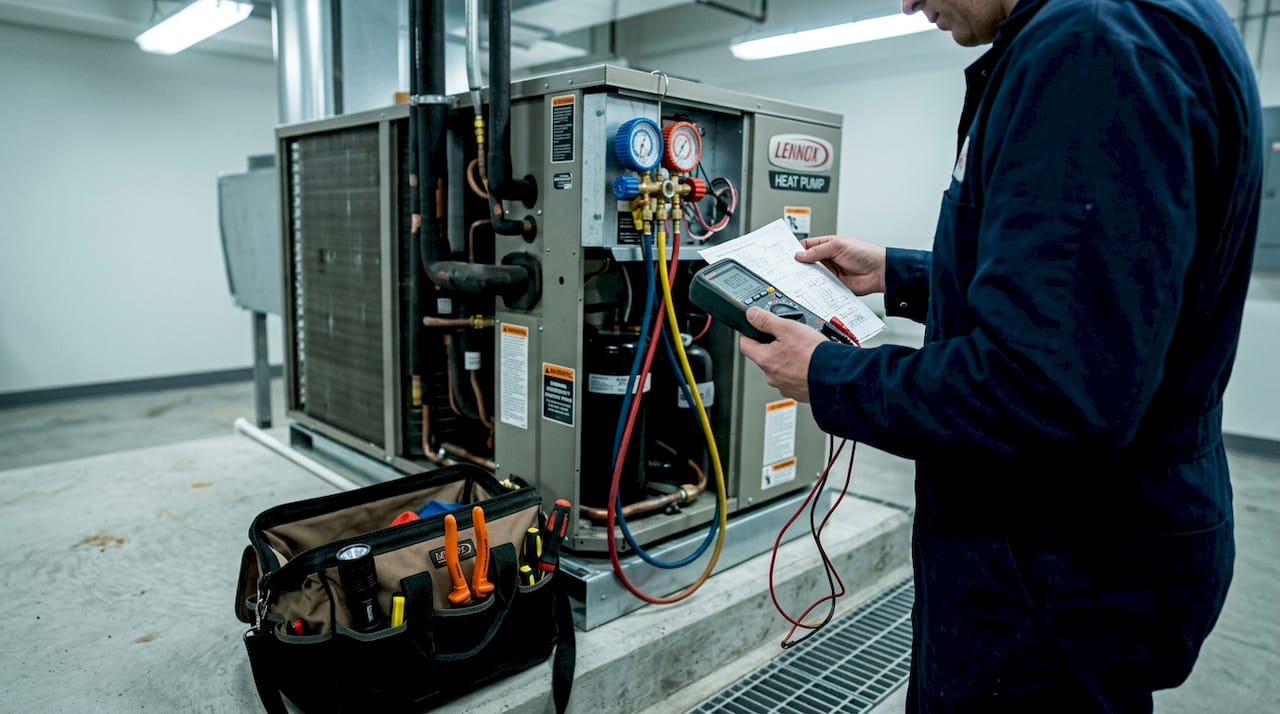
Pro Tip: Always pair your manifold gauges with a micron gauge. Reaching target vacuum means nothing if you can’t verify the reading holds steady after isolating the pump.
For a complete reference, the heat pump component checklist and maintenance workflow for technicians are worth bookmarking. The best HVAC tools resource also provides updated comparisons across brands.
The essential toolkit for homeowners: What you need (and what to avoid)
Not everyone needs the whole suite of tools. Here’s how to equip the average home toolkit correctly.
Homeowners can handle a surprising amount of routine heat pump maintenance safely, as long as they stay within clear boundaries. The basic homeowner toolkit includes screwdrivers, a flashlight or headlamp, a voltage tester or non-contact tester, a basic multimeter, and filter replacement tools for troubleshooting and maintenance.
Here’s what each tool does for you:
- Screwdriver set (flathead and Phillips): Removes access panels so you can inspect components and replace filters.
- Flashlight or headlamp: Lets you see inside the unit clearly without straining. A headlamp keeps both hands free.
- Non-contact voltage tester: Confirms power is off before you touch anything electrical. This is your most important safety tool.
- Basic multimeter: Checks voltage at the thermostat and identifies obvious electrical faults without opening the refrigerant circuit.
- Filter replacement tool: Some systems have awkward filter access. A simple tool makes the job clean and quick.
Safety first: Never open the refrigerant circuit, connect gauges, or attempt electrical repairs beyond basic testing. These tasks require professional training and provincial certification.
For heat pump repair steps that fall within homeowner territory, a good maintenance guide walks you through exactly what to check and when. If you suspect a refrigerant issue, a leak detection guide can help you identify the signs before calling a pro.
Pro Tip: If your heat pump isn’t heating or cooling effectively and you’ve already checked the filter and thermostat settings, stop there. Call a technician. Pushing further without the right tools and training costs more in the long run.
For additional heat pump troubleshooting guidance, there are reliable resources that walk through common fault codes and symptoms step by step.
Professional versus homeowner tools: Side-by-side comparison
To eliminate confusion, here’s a clear breakdown of which tools fit which user and why.
| Task | Tool required | User | Frequency |
|---|---|---|---|
| Filter replacement | Screwdriver, flashlight | Homeowner | Monthly |
| Voltage check at thermostat | Non-contact tester, multimeter | Homeowner | As needed |
| Debris clearing (outdoor unit) | Gloves, garden hose | Homeowner | Seasonal |
| Refrigerant pressure check | Manifold gauges | Pro only | Every service |
| System evacuation | Vacuum pump | Pro only | Every install |
| Electrical diagnostics | Clamp meter or digital multimeter | Pro only | Every service |
| Coil fin repair | Fin straightener | Pro only | Seasonal |
| Thermal diagnostics | Thermal imaging camera | Pro only | As needed |
The tool that surprises most homeowners is the clamp meter. A
digital multimeter or clamp meter, such as the Fluke 117 or Fieldpiece SC260, handles electrical diagnostics including voltage, amperage, and capacitor testing. These are not beginner instruments. Misreading amperage on a compressor circuit can lead to dangerous misjudgements about component health.
Tools that overlap between homeowner and pro use:
- Basic multimeter (homeowners for thermostat voltage, pros for full circuit diagnostics)
- Flashlight or headlamp (universal)
- Screwdriver set (universal)
For repair tips for Canadian homeowners, understanding this boundary clearly is the single biggest factor in avoiding costly mistakes. The professional versus homeowner tool guide reinforces these distinctions with real-world examples.
Trouble-shooting specialty: Edge-case tools and overlooked essentials
Beyond the basics, some tools shine when you face the toughest troubleshooting cases.
Canadian climates create heat pump challenges that don’t appear in most standard tool lists. When temperatures drop below minus 15°C, heat pumps work harder, defrost cycles become more frequent, and subtle performance drops can be easy to miss until they become serious failures.
The tools that matter most in these edge cases:
- Thermal imaging camera: Spots heat loss, insulation gaps, and auxiliary heat activation patterns that no other tool can reveal non-invasively. In cold climates, this is arguably the most valuable diagnostic tool a technician can carry.
- Refrigerant leak detector (electronic): Finds leaks that visual inspection and soap bubbles miss entirely. Essential when a system is underperforming but no obvious fault is visible.
- Defrost cycle tester: Verifies that the defrost board and reversing valve are triggering correctly. A heat pump that doesn’t defrost properly loses efficiency rapidly in Canadian winters.
- Reversing valve solenoid tester: Confirms the valve switches between heating and cooling modes. A stuck reversing valve is a common cold-weather failure that’s easy to misdiagnose without the right tool.
In Canada, tools must handle defrost cycles, reversing valves, and cold-climate performance demands. Thermal imaging is particularly effective for spotting auxiliary heat issues before they become expensive failures.
Skipping these tools on a cold-climate job doesn’t save time. It adds it. A misdiagnosed defrost issue can mean multiple return visits when one proper inspection with the right gear would have resolved it. The heat pump repair workflow for Canadian conditions accounts for exactly these scenarios.
What most lists miss: Lessons from the field
Most tool lists focus on what to buy. Very few talk about what not to buy, and that’s where real money gets wasted.
The most common mistake we see is overbuying. A technician new to heat pump work purchases every gauge, camera, and specialty tester available, then finds that half the kit sits unused because their service area doesn’t demand it. Start with the core tools, use them until you know their limits, then add specialty gear when a specific job demands it.
The second mistake is ignoring personal protective equipment. Gloves, safety glasses, and insulated tools aren’t glamorous, but they prevent the incidents that end careers. No diagnostic tool is worth more than basic PPE.
Field experience also teaches that reliability beats novelty. A well-calibrated analogue manifold gauge from a trusted brand outperforms a cheap digital set with connectivity issues every time. Repeatability matters far more than features when you’re diagnosing under pressure.
The top takeaway after years of heat pump work: confidence comes from knowing your tools deeply, not from owning more of them. Review installation best practices regularly, and invest in training before investing in equipment.
Need expert help or a full-service toolkit?
Knowing which tools you need is a great start. Knowing when to call a professional is even better.

At CoolFix, we support both homeowners and technicians with reliable guidance, step-by-step tutorials, and professional heat pump services across Canada. Whether you’re working through a replacement tutorial on your own or need to understand the full installation timeline before booking a technician, we’ve got resources built for Canadian conditions. Complex installs and repairs done by our team are code-compliant, safe, and backed by real field experience. When you’re ready to move beyond DIY, we’re just a click away.
Frequently asked questions
What are the top three must-have tools for heat pump installation?
Every installer needs manifold gauges and a vacuum pump for installation and charging, plus a digital multimeter for electrical diagnostics. These three tools cover the majority of installation and commissioning tasks.
Can homeowners safely use refrigerant gauges or vacuum pumps?
Homeowners should avoid refrigerant gauges and vacuum pumps entirely. These tools require professional training and provincial certification for safe and legal use in Canada.
Which tools are best for diagnosing heat pump electrical issues?
A digital multimeter or clamp meter is the go-to tool for electrical diagnostics, covering voltage, amperage, and capacitor testing across heat pump circuits.
What tools should be in a homeowner’s basic heat pump toolkit?
Homeowners should keep a screwdriver set, flashlight, voltage tester, basic multimeter, and filter replacement tools on hand for safe routine maintenance and basic checks.
Are there any special tools recommended for Canadian climates?
Yes. Thermal imaging cameras and defrost cycle testers are particularly valuable for diagnosing heat pumps in cold Canadian weather, where defrost and reversing valve issues are more common.
Recommended
- Complete heat pump component checklist for technicians | CoolFix Appliance & HVAC Service
- Optimized Heat Pump Maintenance Workflow for Technicians – CoolFix Appliance & HVAC Service
- Master Heat Pump Repair Workflow for Canadian HVAC Techs – CoolFix Appliance & HVAC Service
- Heat pump leak detection: step-by-step guide for homeowners | CoolFix Appliance & HVAC Service
- Smart HVAC efficiency tips to cut home energy costs
0 Comments