

TL;DR:
- Modern heat pumps operate quietly, typically between 45 and 60 dB(A), similar to a refrigerator or conversation.
- Proper installation and placement are crucial in ensuring noise levels stay within regulations and are barely noticeable indoors.
- Noise complaints are rare in Canada when heat pumps are correctly installed and maintained.
If you’ve been putting off a heat pump because you’ve heard they’re unbearably loud, you’re not alone. Many Canadians share that worry, but the reality is far quieter than the rumours suggest. Noise complaints are rare according to real-world surveys, and modern units are engineered to meet strict limits that protect both you and your neighbours. This guide breaks down what heat pump noise actually sounds like, what regulations govern it, what makes it louder or quieter, and what practical steps you can take to keep your home peaceful.
Table of Contents
- What does heat pump noise actually sound like?
- Heat pump noise regulations and what they mean for you
- Factors that influence heat pump noise levels
- Effective strategies to minimise heat pump noise
- Why most heat pump noise fears are misplaced in Canada
- Get expert help for quiet, efficient heat pumps
- Frequently asked questions
Key Takeaways
| Point | Details |
|---|---|
| Heat pumps are not inherently noisy | Most units run as quietly as typical household appliances and rarely exceed regulated sound levels. |
| Regulations ensure neighbourhood quiet | Strict standards limit nighttime outdoor noise, protecting both you and your neighbours. |
| Installation and maintenance matter | Proper placement, support, and annual checks are the best route to a quiet system. |
| Simple solutions work | Noise barriers, anti-vibration pads, and routine maintenance all provide effective noise control. |
| Concerns are often overblown | Surveys show most homeowners do not experience disruptive noise when heat pumps are installed right. |
What does heat pump noise actually sound like?
Before you can judge whether a heat pump is too loud, it helps to understand how sound is measured. Decibels, written as dB(A), are the standard unit used to measure how loud a sound feels to the human ear. The “A” weighting adjusts the reading to match how people actually perceive noise, filtering out frequencies we barely notice. A small change in dB(A) makes a bigger difference than you’d expect: every 10 dB increase roughly doubles the perceived loudness.
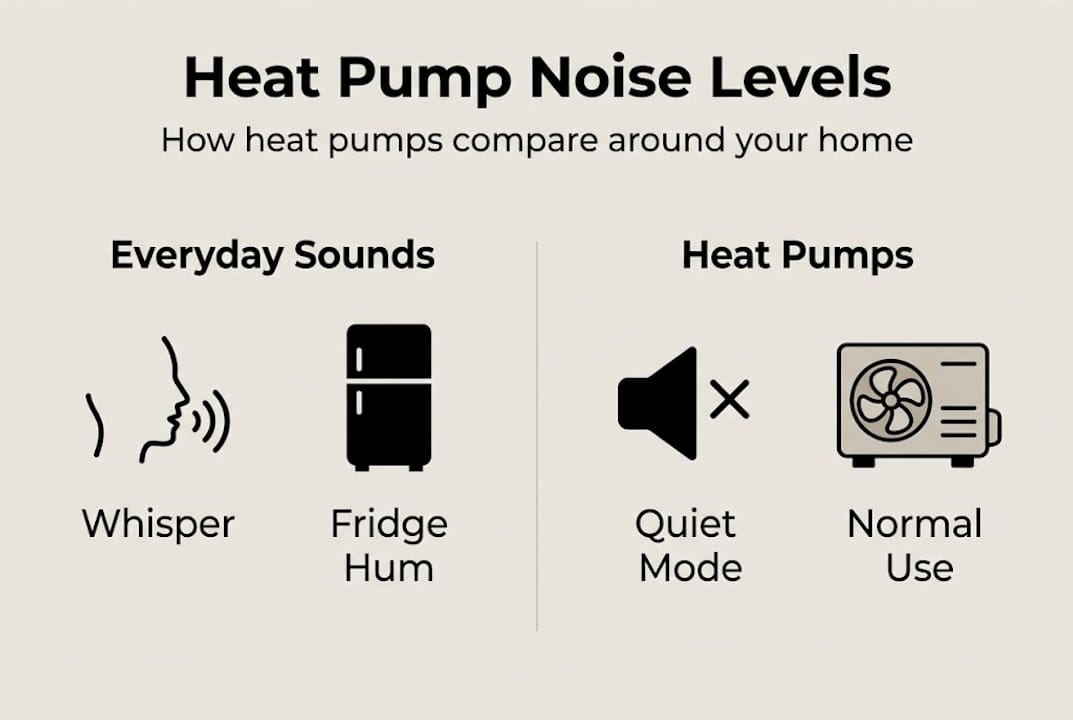
Most residential heat pumps operate somewhere between 45 and 60 dB(A) during normal use. To put that in perspective, here’s how that compares to everyday sounds you already live with:
| Sound | Approximate dB(A) |
|---|---|
| Whisper | 30 dB(A) |
| Quiet library | 40 dB(A) |
| Refrigerator hum | 45 dB(A) |
| Normal conversation | 55 dB(A) |
| Typical heat pump | 45-60 dB(A) |
| Busy restaurant | 70 dB(A) |
| Lawn mower | 85 dB(A) |
As you can see, a running heat pump sits comfortably in the range of a fridge or a relaxed chat. Residential noise limits for heat pumps are typically set at 45 to 55 dB(A) at the property line at night, meaning a properly installed unit should barely register as background noise once you’re inside.
That said, noise isn’t constant. During defrost cycles, when the unit briefly reverses operation to melt ice off the outdoor coil, you may notice a temporary increase in sound. At maximum output on a bitterly cold Canadian night, the fan spins faster and the compressor works harder, pushing noise levels toward the upper end of the range.
Here’s where and when you’re most likely to notice heat pump sound around your home:
- Outdoors, directly beside the unit: This is where noise is loudest, typically 50-60 dB(A).
- At the property line: Noise drops significantly with distance, usually falling within regulated limits.
- Inside the house, nearest exterior wall: A faint hum may be audible in very quiet rooms.
- Bedrooms on the far side of the house: Virtually inaudible under normal conditions.
- During defrost cycles: A brief whooshing or clicking sound that lasts only a few minutes.
Understanding common heat pump noise causes can help you tell normal operation from a problem that needs attention.
Heat pump noise regulations and what they mean for you
Knowing that your heat pump falls within a normal sound range is reassuring, but regulations add another layer of protection for you and your neighbours. In Canada, most municipalities follow noise bylaws that cap residential heat pump sound at 45 to 55 dB(A) measured at the property line during nighttime hours. The UK applies an even stricter standard of 37 dB(A) measured at a neighbour’s window.
Here’s a quick comparison of how noise limits vary by location:
| Location | Noise limit | Measurement point |
|---|---|---|
| Canada (typical) | 45-55 dB(A) at night | Property line |
| United Kingdom | 37 dB(A) | Neighbour’s window |
| Indoor (general) | 35-40 dB(A) | Inside living space |
These limits exist to ensure that heat pumps remain a neighbourly choice. The good news is that noise complaints are rare in real-world surveys, which suggests that most installations already meet or beat these thresholds without special effort.
Regulatory guidance often emphasises placement and shielding as the primary tools for compliance. As one widely referenced standard notes:
“The position of the heat pump relative to neighbouring properties and the use of acoustic barriers are the most effective ways to ensure compliance with local noise limits.”
This matters for you as a homeowner because it means the installer’s decisions, not just the unit itself, determine whether your system stays within legal limits. Before any work begins, ask your installer for the unit’s published noise rating and request a site assessment to confirm that placement will meet your local bylaw. Reviewing heat pump placement best practices ahead of that conversation will help you ask the right questions.
Pro Tip: Request the manufacturer’s dB(A) specification sheet before signing any installation contract. Compare it against your municipality’s nighttime noise bylaw so you know exactly where you stand before the unit goes in the ground.
Factors that influence heat pump noise levels
Not all heat pumps sound the same, and not all installations produce the same noise. Several factors combine to determine how much sound your system actually generates day to day.
- Unit type: Air-source heat pumps have an outdoor fan and compressor that generate more audible noise than ground-source (geothermal) systems, which are largely buried and nearly silent at the surface.
- Compressor speed: Single-speed compressors cycle on and off abruptly, creating noticeable sound spikes. Variable-speed models ramp up and down gradually, keeping average noise much lower.
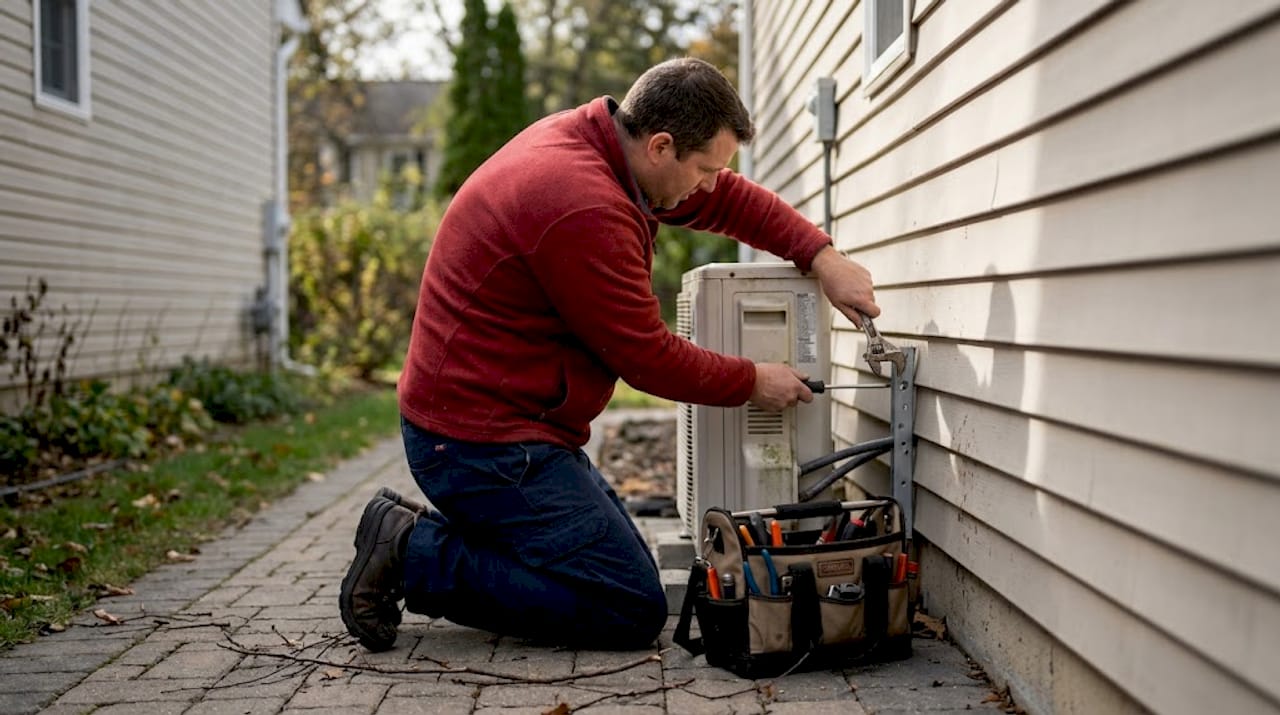
- Installation quality: Loose mounting brackets, poor vibration isolation, and incorrect refrigerant charge all add unnecessary noise that has nothing to do with the unit’s design.
- Placement and surroundings: Units installed in corners or against hard walls can experience sound reflection, amplifying the perceived noise. Open, unobstructed placement performs better acoustically.
- Weather conditions: On very cold days, the compressor runs harder and the fan moves more air. Defrost cycles and cold weather can temporarily increase noise by 5 to 10 dB, which is normal and expected.
- Age and maintenance: Worn bearings, dirty coils, and loose panels all add vibration and rattling that a well-maintained unit wouldn’t produce.
The difference between a noisy installation and a quiet one often comes down to choices made before the unit even turns on. Troubleshooting heat pump noises becomes much easier once you understand which factor is most likely at play.
Pro Tip: If minimising noise is your top priority, ask specifically about variable-speed or inverter-driven models. They cost a bit more upfront but run significantly quieter during the long stretches of moderate demand that make up most of a Canadian heating season. Pairing that choice with proper maintenance for quieter heat pumps keeps the advantage going year after year.
Effective strategies to minimise heat pump noise
Once you understand what drives noise, you have real tools to manage it. Whether you’re planning a new installation or dealing with an existing unit that’s louder than you’d like, these measures make a genuine difference.
- Strategic placement: Position the outdoor unit away from bedroom windows, fences that reflect sound, and enclosed corners. Distance and open space are your best allies. Proper placement, anti-vibration pads, and barriers can deliver reductions of 10 dB or more, which is the difference between noticeable and barely audible.
- Anti-vibration pads and mounts: Rubber isolation pads placed under the unit absorb compressor vibration before it travels through the pad, the wall, or the ground into your home.
- Acoustic barriers: A solid fence, dense hedge, or purpose-built acoustic screen placed between the unit and the noise-sensitive area can cut perceived sound significantly without restricting airflow.
- Proper refrigerant charge and airflow: An undercharged or overcharged system strains the compressor, increasing noise. A qualified technician should verify this at installation and during annual servicing.
- Regular cleaning: Dirty coils force the fan and compressor to work harder. Keeping the outdoor unit clear of leaves, snow, and debris is one of the simplest ways to maintain quiet operation.
- Annual professional servicing: A technician can catch loose panels, worn bearings, and refrigerant issues before they become noise problems. Following essential heat pump maintenance steps each year is the single most reliable way to keep sound levels low over the long term.
Pro Tip: If you’re building or renovating and noise is a serious concern, ask about ground-source heat pumps. The outdoor noise footprint is minimal since the main mechanical components are indoors, making them ideal for tight urban lots or properties with close neighbours.
For existing installations that have become noisier over time, repair tips for heat pumps can help you identify whether the issue is a quick fix or something that needs professional attention.
Why most heat pump noise fears are misplaced in Canada
We’ve worked with enough Canadian homeowners to recognise a pattern: the loudest voices about heat pump noise are usually people who’ve never actually lived with a modern unit. The horror stories circulating in neighbourhood groups tend to trace back to older equipment, poor installations, or unusual circumstances, not to the technology itself.
The data backs this up. Noise complaints are rare in real-world surveys of homeowners who’ve actually made the switch. That’s not a marketing claim. It reflects the reality that modern variable-speed units, installed correctly, simply don’t generate the kind of sound that disrupts daily life.
What we’ve seen time and again is that installation quality matters far more than the brand or model you choose. A premium unit placed in a sound-reflecting corner, mounted without vibration isolation, will be louder than a mid-range unit installed thoughtfully. Focusing your energy on vetting your installer and understanding how to extend heat pump life through proper care will serve you better than obsessing over spec sheets.
Edge cases do exist. Unusually cold Canadian winters can push defrost cycles harder, and a unit that hasn’t been serviced in years will inevitably get louder. But these are manageable situations, not reasons to avoid the technology altogether.
Get expert help for quiet, efficient heat pumps
If you want peace of mind along with a quieter home, getting the installation right from the start is the most important step you can take.

At CoolFix, we specialise in heat pump installation and appliance repair for Canadian homeowners who want reliable, quiet performance year-round. Our team offers site assessments to confirm ideal placement, advises on models that meet your noise and efficiency goals, and provides ongoing servicing to keep your system running smoothly. Whether you’re starting fresh with a heat pump replacement or want to make sure your current unit is set up right, our installation best practices guides are a great place to start. Reach out today for a consultation.
Frequently asked questions
How loud is a typical heat pump?
Most residential heat pumps run at 45 to 60 dB(A), which is roughly as loud as a quiet conversation or a refrigerator hum. Noise limits at the property line are typically set at 45 to 55 dB(A) at night, so a properly installed unit should stay well within comfortable range.
Can I reduce my heat pump noise after it’s installed?
Yes, several options are available even after installation. Anti-vibration pads, barriers, and maintenance can meaningfully reduce noise, and in some cases repositioning the unit is also feasible.
Why does my heat pump get louder in winter?
Defrost cycles and cold weather can temporarily increase heat pump noise by 5 to 10 dB. This is a normal part of operation and not a sign that something is wrong with your unit.
Are complaints about heat pump noise common?
No. Noise complaints are rare in real-world surveys, particularly when the system has been installed with proper placement and vibration isolation in mind.
Recommended
- How heat pumps transfer heat: A homeowner’s guide | CoolFix Appliance & HVAC Service
- Heat pump terminology explained for Canadian homeowners 2026 – CoolFix Appliance & HVAC Service
- Demystifying heat pump terms for Canadian homeowners | CoolFix Appliance & HVAC Service
- Heat pumps vs traditional HVAC: what Canadian homeowners need to know | CoolFix Appliance & HVAC Service
0 Comments