
If your house has hot upstairs bedrooms, a stuffy back addition, or aging ductwork that never seems to cool evenly, the ductless ac vs central question gets real fast. This is not just about brand preference or what your neighbor installed. It comes down to how your home is laid out, how you use each room, and how much money you want tied up in installation, operation, and future repairs.
For a lot of homeowners, the wrong choice is not the system that costs more up front. It is the one that does not match the house. A well-installed central system can cool an entire home quietly and consistently. A properly sized ductless system can solve comfort problems central air struggles with. Both can be smart choices. Both can also be a headache when they are forced into the wrong job.
Ductless AC vs central: the basic difference
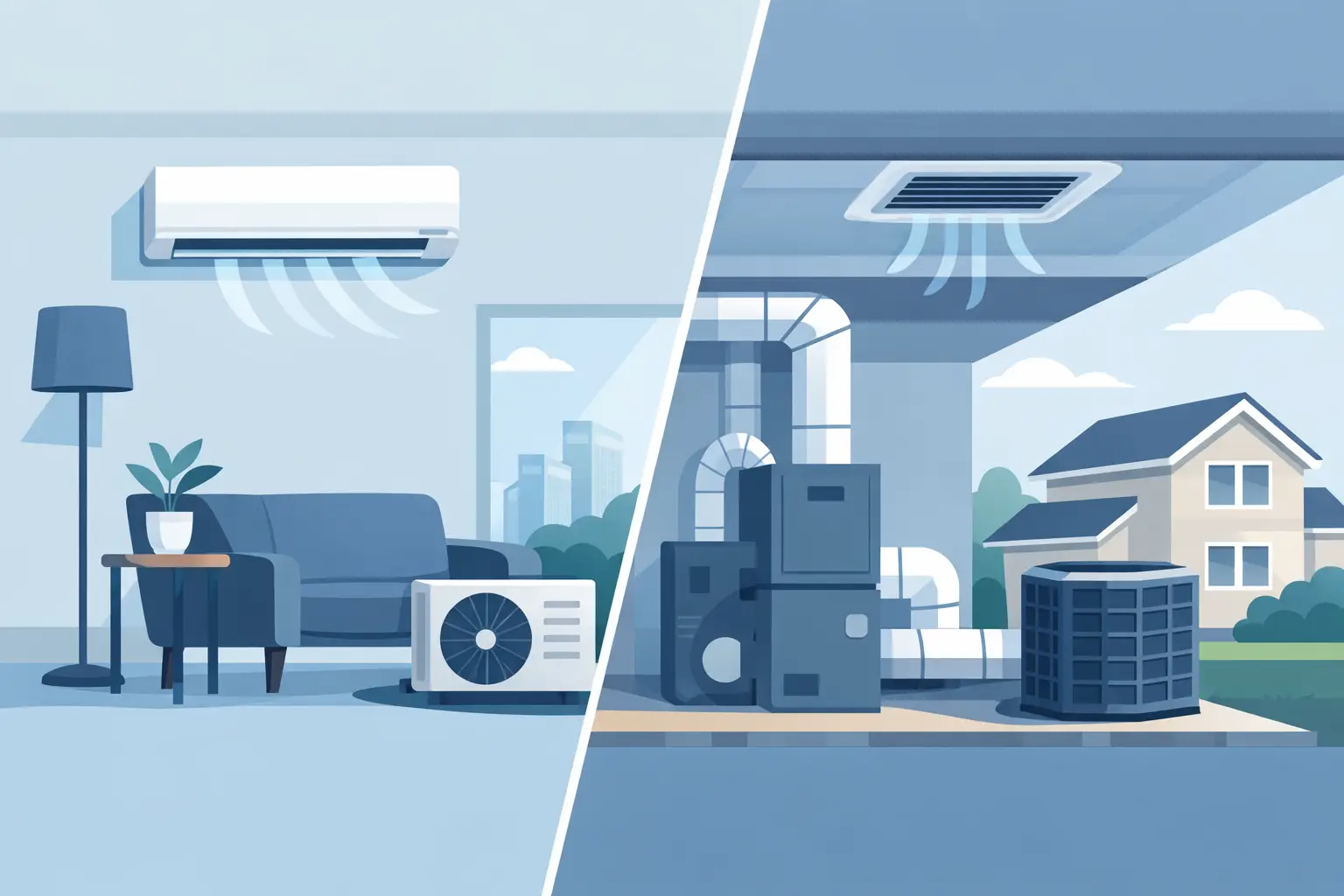
Central air uses one indoor evaporator coil and one outdoor unit to cool the house through a duct system. Air is pushed room to room through supply vents and returned through return ducts. If your home already has solid ductwork, central air often feels like the most familiar and straightforward option.
Ductless air conditioning, often called mini-split, skips the duct system. It uses an outdoor unit connected to one or more indoor wall, ceiling, or floor-mounted units. Each indoor unit cools its own zone. That means you are not trying to force one temperature across every room whether you use them or not.
That difference matters more than people think. Central air is built for whole-home cooling from one system. Ductless is built for room-by-room control. Once you understand that, the decision gets easier.
When central air makes more sense
Central air usually works best when the home already has ductwork in good shape, the layout is fairly open, and the goal is even cooling across most of the house. If you are cooling a typical single-family home and every bedroom, hallway, and main living area needs air at the same time, central can be the cleaner solution.
There is also the comfort factor. Many homeowners like central because it is quiet inside the home and largely out of sight. You get one thermostat, one system, and consistent airflow through the house. For families who do not want to think about zones, remotes, or multiple indoor heads on the wall, that simplicity is a real advantage.
Central can also pair well with an existing furnace setup. If you already have a forced-air furnace and usable ducts, adding or replacing central AC may be more practical than installing several ductless heads throughout the house.
But there is a catch. Those benefits depend heavily on the duct system. If the ducts are leaky, undersized, poorly routed, or buried in a hot attic with little insulation, central air can lose a lot of efficiency and struggle to cool evenly.
When ductless AC is the better fit
Ductless shines in homes where central air is hard to install well or where comfort problems are isolated to certain areas. Think older homes without ducts, room additions, converted garages, upper floors that run hot, basement suites, or rental units where separate control is useful.
It also makes sense when people use rooms differently. If one person likes a cool bedroom at night and another barely uses the guest room, ductless zoning lets you cool only the spaces that need it. That can reduce waste, especially in households where parts of the home sit empty for long stretches.
For landlords and property managers, ductless can be useful in select situations because it allows targeted cooling without reworking an entire house. If one suite, office, or problem room needs dependable cooling, a mini-split may solve the issue with less disruption than extending or rebuilding ductwork.
Still, ductless is not automatically cheaper just because it avoids ducts. A single-zone system can be affordable. A whole-home multi-zone setup with several indoor units can add up quickly.
Installation cost is not the whole story
A lot of people ask which system is cheaper. The honest answer is that it depends on what your house already has.
If your home already has good ducts and a compatible air handler or furnace setup, central air may be the lower-cost path for whole-home cooling. The major infrastructure is already there. In that case, ductless may only win on cost if you are cooling one or two specific areas.
If your home has no ducts, bad ducts, or major airflow issues, central gets more expensive fast. Adding ductwork is not a small detail. It can mean opening walls or ceilings, changing chases, balancing airflow, and dealing with space limitations. In that situation, ductless often becomes the more practical option.
Operating cost also depends on usage. Ductless can save money when zoning is used properly. If you cool only occupied rooms, you avoid conditioning the whole house unnecessarily. But if every indoor unit runs all day to cover the entire home, the savings may not be as dramatic as people expect.
Comfort and temperature control
This is where ductless ac vs central often comes down to real-life living rather than equipment specs.
Central air tends to deliver a more uniform feel when the system is sized correctly and the ducts are balanced well. The house feels whole. Air is distributed across the home, and you are less likely to notice major differences between one main room and another.
Ductless offers better control by zone. That is great for problem areas and households with different comfort preferences. It is especially helpful in homes where one part of the house heats up faster than the rest. Instead of overcooling the entire home to fix one hot bedroom, you can target that room directly.
The trade-off is that ductless does not always feel as blended from room to room, especially if doors stay closed and indoor unit placement is not ideal. It cools the spaces it serves very well, but airflow patterns are different from a whole-house ducted system.
Efficiency depends on the house, not just the label
People often assume ductless always wins on efficiency. On paper, many mini-splits are very efficient. In practice, performance depends on installation quality, sizing, home layout, insulation, and how the system is used.
Ductless avoids duct losses, which is a genuine advantage. If your home has old or leaking ducts, that can be a big deal. But a high-efficiency central system with tight, well-designed ducts can still perform very well.
The main mistake is buying based on ratings alone. A top-rated system installed poorly will not deliver the comfort or savings you were promised. Proper sizing matters just as much as equipment choice. Oversized systems short cycle. Undersized systems run too hard. Either way, comfort suffers and wear goes up.
Maintenance and repair differences
Both systems need maintenance. Neither is maintenance-free.
Central air has fewer visible indoor components, which some homeowners prefer. Filter changes are simple, and annual service usually focuses on the outdoor unit, coil, drain, electrical components, refrigerant performance, and airflow. If the duct system has issues, though, that adds another layer of maintenance and diagnosis.
Ductless systems need regular cleaning of their indoor heads and filters. That part often gets skipped because the units keep running, at least for a while. Then performance drops, drainage problems show up, or indoor air quality suffers. If you have multiple heads, you also have multiple indoor components to maintain.
From a repair standpoint, central systems are often simpler for homeowners who want one system to manage. Ductless can be excellent, but more indoor units mean more parts in play. That does not make ductless unreliable. It just means maintenance habits matter.
So which one should you choose?
Choose central air if your home already has good ductwork, you want one system for whole-home cooling, and you prefer a cleaner look with fewer indoor units on display. It is often the better fit for homes built around forced-air heating and for families who want simple, even comfort.
Choose ductless if your home lacks ducts, certain rooms are always uncomfortable, or you want true zone control. It is also a strong option for additions, older homes, and targeted cooling where running new ductwork would be expensive or disruptive.
If you are stuck between the two, start with the house itself. Look at the duct condition, room layout, insulation, and which areas actually need cooling. That usually tells the story faster than any sales pitch.
At CoolFix, we see plenty of situations where repair, rebalancing, or a targeted ductless addition makes more sense than a full replacement. The best system is the one that solves the problem without saddling you with extra cost you did not need.
A good cooling setup should make your home easier to live in, not harder to afford. When the choice matches the house, you feel it every day.
0 Comments