

TL;DR:
- Understanding heat pump terms helps homeowners make informed decisions and save money.
- Key ratings like SEER and HSPF directly impact energy efficiency and monthly bills.
- Asking specific questions about these ratings improves communication with HVAC professionals.
Hearing your HVAC technician rattle off terms like SEER, HSPF, COP, and two-stage compressors can make your head spin. For most homeowners, this alphabet soup of jargon creates more confusion than confidence, and that confusion can cost you real money. When you don’t understand what you’re being sold, it’s harder to compare quotes, ask the right questions, or know whether a recommended upgrade actually suits your home. This guide breaks down the most important heat pump industry terms in plain language, so you can walk into any installation or repair conversation feeling informed, prepared, and in control of your decisions.
Table of Contents
- Why industry terms matter for your home
- Breaking down the most common heat pump terms
- Comparing heat pump features: what matters most?
- Using the right terms with your HVAC pro
- A new way to think about heat pump terminology
- Ready to put your knowledge to work?
- Frequently asked questions
Key Takeaways
| Point | Details |
|---|---|
| Understand the basics | Knowing the meaning of SEER, HSPF, and COP gives you power to compare heat pump options. |
| Ask the right questions | Using industry terms in conversations ensures you get the right system for your home. |
| Performance varies by climate | Cold-weather suitability matters as much as headline efficiency ratings for Canadian homes. |
| Knowledge saves money | Informed homeowners can avoid unnecessary upgrades and lower their energy bills. |
Why industry terms matter for your home
Decoding heat pump terminology isn’t just an academic exercise. It’s a practical skill that directly affects your comfort, your energy bills, and how much you spend on installation or repairs. Heat pump terminology helps homeowners make better energy and cost decisions, and that starts with understanding what those terms actually mean in the real world.
Think about it this way: if a contractor quotes you two different systems at similar prices, but one has a significantly higher SEER rating and better HSPF, you’re looking at years of lower energy bills. Without knowing what those numbers mean, you might choose based on brand name alone, or worse, pick the cheaper upfront option that costs far more to run.
Here are some of the most common terms that trip homeowners up:
- SEER (Seasonal Energy Efficiency Ratio): measures cooling efficiency
- HSPF (Heating Seasonal Performance Factor): measures heating efficiency
- COP (Coefficient of Performance): a snapshot efficiency rating at a single temperature
- BTU (British Thermal Unit): measures heating or cooling capacity
- Two-stage compressor: a compressor that runs at two speeds for better comfort and efficiency
Misunderstanding these terms leads to real consequences. You might overpay for a system that’s poorly matched to your climate, or accept a repair quote without knowing whether the fix is worth the cost. The benefits of heat pump installation are only realised when the right system is chosen for the right home.
“The homeowner who asks one good question saves more than the one who signs without reading.”
Pro Tip: Keep a small notepad handy during any HVAC consultation. Write down every unfamiliar term and ask your technician to explain it in plain language before moving on. A professional who respects your time will welcome the question.
Clear communication isn’t just polite. It’s the foundation of a smart purchase. When you understand the language, you can compare solutions, push back on unnecessary upsells, and make choices that genuinely serve your home’s needs.
Breaking down the most common heat pump terms
Now that you know why these terms are important, let’s simplify the key heat pump industry terms you’ll encounter. Each one plays a specific role in how your system performs, and knowing what they mean helps you compare models with confidence.
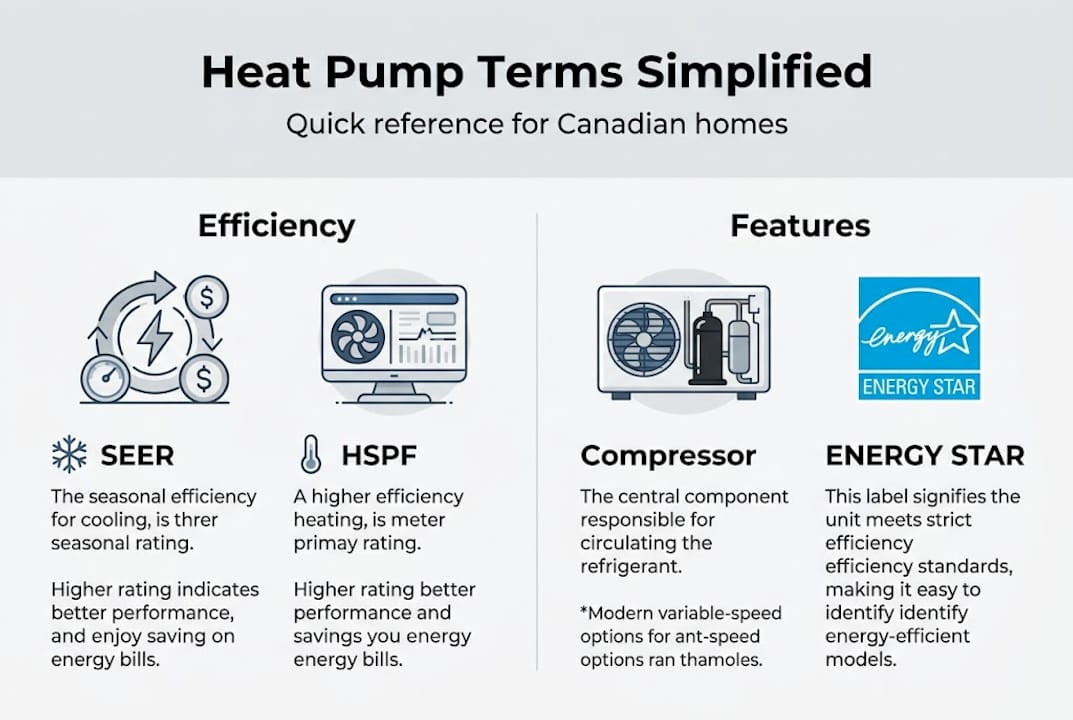
Upgrading to a high-SEER model may reduce energy use by up to 25%, which adds up to significant savings over the life of a system. That’s not a marketing claim; it’s a measurable outcome tied directly to the efficiency rating you choose.
Here’s a quick-reference table to keep things clear:
| Term | What it means | Why it matters |
|---|---|---|
| SEER | Cooling efficiency over a season | Higher SEER = lower summer energy bills |
| HSPF | Heating efficiency over a season | Higher HSPF = lower winter heating costs |
| COP | Efficiency at one specific temperature | Useful for comparing units in lab conditions |
| BTU | Heating or cooling capacity | Determines if a unit can handle your home’s size |
| Two-stage compressor | Runs at low or high speed as needed | Better comfort, quieter operation, less energy waste |
| Variable-speed compressor | Adjusts continuously across many speeds | Maximum efficiency and precise temperature control |
Key terms like SEER, HSPF, and two-stage compressors are critical for evaluating performance, and they’re the first things worth comparing when you receive competing quotes.
Here’s what these terms look like in practice. If you’re comparing two units and one has a SEER of 14 while the other has a SEER of 20, the second unit will use noticeably less electricity to cool your home each summer. Over ten years, that difference compounds into hundreds of dollars in savings.
- HSPF is equally important for Canadian winters, where heating efficiency can make or break your monthly bills
- BTU sizing must match your home’s square footage; too small and the unit struggles, too large and it short-cycles
- Variable-speed compressors are generally quieter and more efficient than single-stage units, though they carry a higher upfront cost
Pro Tip: Always ask for both the HSPF and SEER values before making a final selection. A unit that shines in summer cooling may underperform in a cold Canadian winter if its HSPF is low.
Comparing heat pump features: what matters most?
Once familiar with the terms, it’s time to focus on practical feature comparisons that pay off. Knowing the definitions is step one; using them to evaluate real products is where the knowledge becomes valuable.

Comparing SEER and HSPF ratings is essential for maximising both comfort and savings, but those numbers don’t tell the whole story. You also need to consider compressor type, ENERGY STAR certification, and how the unit handles defrost cycles in cold weather.
Here’s a step-by-step approach to comparing models confidently:
- List the SEER and HSPF of every model you’re considering side by side
- Check for ENERGY STAR certification, which confirms the unit meets government efficiency standards
- Identify the compressor type: single-stage, two-stage, or variable-speed
- Ask about defrost cycle behaviour, especially important for Canadian winters where ice build-up is common
- Factor in the warranty, including parts, labour, and compressor coverage
Here’s a sample comparison to illustrate what this looks like in practice:
| Feature | Model A | Model B |
|---|---|---|
| SEER | 16 | 22 |
| HSPF | 8.5 | 10.5 |
| Compressor | Single-stage | Variable-speed |
| ENERGY STAR | Yes | Yes |
| Estimated annual savings | Moderate | High |
When you compare heat pumps vs traditional HVAC systems, the efficiency gap becomes even more apparent. Heat pumps move heat rather than generate it, which is inherently more efficient, but only if the ratings match your climate.
Pro Tip: A high SEER rating doesn’t automatically mean strong cold-weather performance. In regions with harsh winters, a unit with a lower SEER but a higher HSPF may serve you far better from October through April. Always weigh both numbers against your local climate before deciding.
Understanding factors affecting heat pump costs also helps you see why a more efficient unit often pays for itself within a few years, even if the upfront price is higher.
Using the right terms with your HVAC pro
Armed with new knowledge, here’s how to use those terms to your advantage during real-life conversations with HVAC professionals. Knowing the vocabulary transforms you from a passive recipient of advice into an active participant in the decision.
Clear communication with installers leads to better outcomes for homeowners, and it starts with asking the right questions before any work begins.
Here are some questions worth bringing to your next quote or service call:
- What is the SEER rating of this model, and how does it compare to other options at this price point?
- What HSPF should I expect, and how will that affect my heating bills this winter?
- Is this unit ENERGY STAR certified?
- Does it use a single-stage, two-stage, or variable-speed compressor?
- How does the defrost cycle work in temperatures below minus 15 degrees Celsius?
- What does the warranty cover, and for how long?
These aren’t aggressive questions. They’re reasonable, informed requests that any reputable technician should be able to answer without hesitation. If a contractor stumbles or deflects, that tells you something important about their expertise.
“A few well-placed questions help ensure you get the right system for your home.”
You can also use your knowledge during repair calls. If a technician recommends replacing a component, ask how the repair affects the overall heat pump repair workflow and whether it makes more sense to repair or replace the unit given its age and efficiency ratings.
The goal isn’t to challenge your HVAC professional. It’s to build a productive partnership where both sides communicate clearly. Technicians genuinely appreciate homeowners who engage, because it makes the job easier and reduces the chance of mismatched expectations.
A new way to think about heat pump terminology
Here’s an uncomfortable truth most people in the HVAC industry won’t say out loud: complex terminology benefits sellers more than buyers. When a homeowner doesn’t understand the difference between SEER and HSPF, it’s much easier to steer them toward a higher-margin product that may not be the best fit.
This isn’t about distrust. Most HVAC professionals are skilled and honest. But the system itself, with its acronyms and ratings and compressor classifications, creates an information gap that can work against you if you’re not prepared.
Knowledgeable homeowners are simply harder to upsell unnecessarily. When you walk in understanding what you need and why, the conversation shifts. You’re no longer just approving a quote; you’re evaluating it. That confidence shows, and it tends to earn more respect from the professionals you work with.
Understanding key factors for savings is part of that shift. Plain-language knowledge doesn’t just help you save money; it gives you the confidence to make decisions you feel good about for years to come.
Ready to put your knowledge to work?
Now that the jargon makes sense, the next step is putting that understanding into action. Whether you’re planning a new installation, weighing a replacement, or trying to make sense of a repair quote, CoolFix is here to help you move forward with clarity.

Explore our heat pump replacement tutorial to see what the process looks like from start to finish, or review our best installation practices to know what questions to ask before any work begins. If you need hands-on help, our appliance repair services connect you with experienced technicians who communicate in plain language. You’ve done the learning. Now let’s make it count.
Frequently asked questions
What does SEER mean for heat pumps?
SEER measures cooling efficiency and is the Seasonal Energy Efficiency Ratio; a higher SEER rating means your heat pump uses less electricity to cool your home during summer months.
How does HSPF affect my winter heating bill?
A higher HSPF heating efficiency rating means your heat pump draws less power to produce the same amount of warmth, which directly lowers your energy costs through a Canadian winter.
Which terms should I ask about during a heat pump quote?
Focus on SEER, HSPF, compressor type, and ENERGY STAR certification; these core industry terms give you the clearest picture of long-term value and performance.
Are high SEER heat pumps always best for Canadian climates?
Not always; in colder regions, cold weather performance depends more on HSPF than SEER, so always compare both ratings against your local winter conditions before choosing a model.
Recommended
- Heat pump terminology explained for Canadian homeowners 2026 – CoolFix Appliance & HVAC Service
- Heat Pump System Terminology – Impact on Canadian Repairs – CoolFix Appliance & HVAC Service
- Heat pumps vs traditional HVAC: what Canadian homeowners need to know | CoolFix Appliance & HVAC Service
- Heat Pump Water Heating Explained: Energy Savings for Canadians – CoolFix Appliance & HVAC Service
0 Comments