
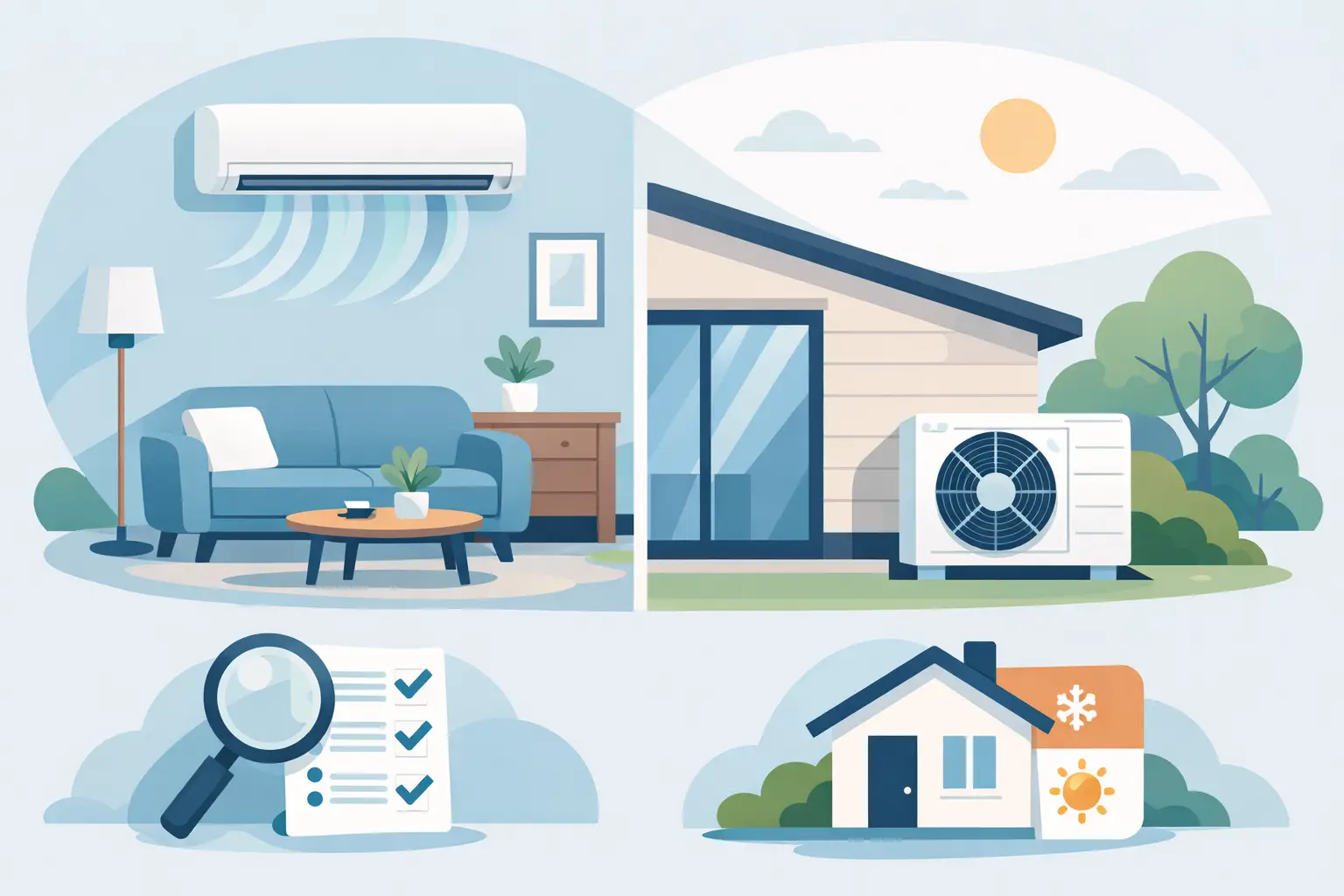
A ductless system can solve a problem that central air cannot touch: one bedroom that never cools down, a finished basement, a garage workspace, or an older home with no practical place for ductwork. This ductless air conditioner buying guide explains what to look for before you spend money, so you can choose equipment that fits your space instead of paying for a system that is too big, too small, or too complicated for the job.
Ductless air conditioners, often called mini-splits, use an outdoor unit connected to one or more indoor air handlers. Each indoor unit cools a specific room or zone. Because there are no large ducts to install, they can be a practical option for additions, rental units, older houses, and rooms with uneven temperatures.
Start With the Problem You Need to Solve
The right ductless unit depends less on the brand name and more on what is happening in your home. If your entire house is uncomfortable, a single wall-mounted head in the living room may not be enough. If one upstairs bedroom stays hot while the rest of the house is fine, a single-zone system could be an efficient fix.
Think about how the room is used. A rarely used guest room has different needs than a home office occupied every day. A sunny room with large west-facing windows, a kitchen with frequent cooking, or a garage with little insulation will carry a heavier cooling load than another room of the same size.
For landlords and property managers, ductless units can also offer more control in suites or individual rooms. That said, more zones mean more equipment to maintain and more decisions around who controls the temperature. Simple is usually better when it meets the comfort need.
Size the System Correctly
Sizing is the most important part of any ductless air conditioner buying guide. Mini-splits are commonly rated in BTUs, which describe how much heating or cooling capacity the equipment can provide. It is tempting to use a basic square-footage chart and call it done, but those charts are only a starting point.
A unit that is too small may run constantly on hot days and still leave the room uncomfortable. A unit that is too large can cool the air too quickly, shut off before removing enough humidity, and cycle more than it should. That can make a room feel cool but clammy, while also adding wear to the system.
A proper sizing decision considers the room’s square footage, ceiling height, insulation, window area, sun exposure, number of occupants, nearby heat sources, and whether doors are usually open or closed. In a cold-winter climate, heating performance matters too. A mini-split that looks good for summer cooling may not be the right choice if you expect it to carry meaningful heating duty when temperatures drop.
Do not assume one head cools every room
Air moves poorly around corners, through narrow hallways, and behind closed doors. A wall unit in an open living area can work very well, but it will not reliably cool several separated bedrooms just because the total square footage looks right on paper.
If your home has an open layout, one larger unit may make sense. If rooms are closed off most of the day, separate zones or another cooling approach may be more realistic. An honest assessment upfront is cheaper than trying to force one unit to do a job it was never designed to do.
Choose Between Single-Zone and Multi-Zone Systems
A single-zone mini-split has one outdoor unit and one indoor head. It is often the most straightforward and cost-effective option for a specific problem room, addition, or small suite. It is also easier to diagnose when an issue comes up because there are fewer components involved.
A multi-zone system connects several indoor heads to one outdoor unit. This can reduce the number of outdoor condensers around the property and allow different rooms to have separate temperature settings. It can be a strong fit for a home without ducts or a property where several rooms need attention.
The trade-off is cost and complexity. Multi-zone equipment usually requires more planning, longer line runs, more electrical considerations, and careful load calculations. If the outdoor unit has a problem, multiple rooms may be affected. For some homes, several single-zone systems are worth comparing against one multi-zone system before making a final choice.
Look Beyond the Cooling Rating
Efficiency matters, especially if the unit will run through much of the summer. Higher-efficiency models may cost more upfront but can use less electricity over time. Still, the highest rating on the box is not automatically the best value for every household.
Consider how often you will use the system and what features actually help you. Variable-speed inverter compressors are common in quality ductless systems and can adjust output instead of simply turning on and off at full power. This generally supports steadier temperatures, quieter operation, and better efficiency during long run times.
If you want the unit to provide heat during spring, fall, or winter, check its heating capacity at low outdoor temperatures. Do not rely only on a broad statement that it is a heat pump. Ask how much heat it can produce in cold conditions and whether it needs backup heat for your home and climate.
Other features can be useful, but they should not drive the purchase by themselves. Wi-Fi controls are handy for landlords, travelers, and anyone who wants to check settings remotely. A quieter indoor unit can matter in bedrooms. Washable filters make routine care easier. Those benefits are real, but correct sizing and quality installation matter more than a long feature list.
Plan the Installation Before You Buy
Ductless equipment is less invasive than adding full ductwork, but it is not a plug-in appliance. The indoor and outdoor units must be placed where they can perform properly and be serviced later. Refrigerant lines, wiring, and a condensate drain need a safe route between them.
Indoor heads should be high enough on the wall to distribute air well, with enough clear space around them for airflow and maintenance. Avoid placing one where it will blast directly onto a bed, desk, dining table, or favorite chair. A good location cools the room without making one person feel like they are sitting in a wind tunnel.
The outdoor unit needs stable support, clear airflow, and room for a technician to access it. It should also be protected from damage caused by lawn equipment, snow buildup, roof runoff, or drifting debris. In areas around Winkler, Morden, Carman, and Altona, winter placement deserves special attention. An outdoor heat pump unit needs to handle snow and drainage conditions, not just look tidy in July.
Electrical capacity is another item to check early. Some installations need a new dedicated circuit or panel work. This is not the place to cut corners. Proper electrical work, line sizing, evacuation, drainage, and commissioning all affect system life and performance.
Factor In the Full Cost, Not Just the Equipment Price
A low equipment price can be misleading if it excludes the installation work needed to make the system reliable. Compare estimates based on the complete job: equipment, line set length, wall penetration, mounting, electrical work, condensate drainage, startup, and warranty coverage.
Ask what happens if the standard line length is not enough or if the installation requires a pump for condensate. These are common job-specific costs, not necessarily red flags. The goal is to understand them before work begins.
It is also smart to ask about parts availability and local service support. A bargain system is less of a bargain if replacement parts are hard to source or no local technician is willing to service it. CoolFix recommends choosing equipment that can be maintained properly, because repairability often protects your budget better than chasing the lowest upfront price.
Keep Your New Ductless System Working
Mini-splits need routine care, even though they do not use a large central-air filter. Clean or wash the indoor filters as directed, especially during heavy use. Keep the outdoor unit clear of leaves, grass clippings, snow, and other blockage. Watch for water dripping indoors, unusual noise, weak airflow, ice buildup, or a decline in cooling performance.
A professional maintenance visit can catch dirty coils, drain issues, electrical concerns, refrigerant leaks, and wear before they turn into a no-cooling call on the hottest week of the year. Maintenance also gives you a chance to ask whether the unit is still operating as efficiently as it should.
The best ductless system is not necessarily the biggest, fanciest, or cheapest one. It is the unit that is properly sized, carefully installed, practical to maintain, and matched to the way your household actually lives. A few good questions before buying can keep one small comfort upgrade from becoming an expensive headache later.
0 Comments