
Managing uneven comfort in Canadian homes often means battling rooms that are too cold upstairs and too warm downstairs. The drive for efficiency and satisfied customers makes understanding heat pump zoning strategies crucial for every Canadian HVAC technician. By dividing spaces based on real needs and smart controls, you can deliver tailored comfort while reducing energy waste, even during harsh winters. This guide breaks down practical zoning principles that make your heat pump installations perform better from day one.
Table of Contents
- Heat Pump Zoning Basics And Key Concepts
- Comparing Zoning System Types And Configurations
- Designing Residential Zones For Optimal Performance
- Installation, Controls, And Commissioning Essentials
- Legal Standards, Code Compliance, And Technician Roles
- Common Zoning Errors And Cost-Saving Opportunities
Key Takeaways
| Point | Details |
|---|---|
| Heat Pump Zoning Enhances Efficiency | Zoning allows for targeted heating and cooling in specific areas, which significantly reduces energy consumption compared to treating the entire home as a single unit. |
| Understanding Zoning Configurations is Essential | Different zoning systems, such as single-zone, multi-zone, and hybrid setups, cater to varying home layouts and can provide substantial energy savings based on proper configuration. |
| Strategic Zone Design Maximizes Comfort | Effective zone design should take into account occupancy patterns and thermal loads to ensure consistent comfort and avoid wasted energy in unoccupied spaces. |
| Proper Installation and Compliance are Crucial | Meticulous installation, thorough commissioning, and adherence to local building codes ensure the system operates as intended and protects against potential liabilities. |
Heat pump zoning basics and key concepts
Heat pump zoning splits your heating and cooling system into separate zones, allowing different areas of a home to operate at different temperatures. Rather than treating your entire house as one heating unit, zoning uses dampers in your ductwork and a smart thermostat to direct conditioned air exactly where it’s needed. For Canadian homeowners dealing with variable climate demands across different rooms and seasons, this approach transforms how efficiently your heat pump system performs. The core principle is straightforward: why heat a guest bedroom to 21°C when it sits empty, or cool a basement that nobody uses during winter months?
Understanding how heat pumps work provides the foundation for effective zoning. Heat pumps transfer thermal energy rather than generating heat through resistance, making them exceptionally efficient even in Canadian climates as cold as minus 30°C. When you layer zoning onto this already efficient system, you multiply your savings. A single zone heat pump might run continuously to condition the entire house. A zoned system runs only to maintain your target temperatures in occupied spaces, dramatically reducing runtime and electricity consumption. This is where the mathematics becomes compelling: if zoning allows your system to run 40 percent less, your heating costs drop proportionally.
Zoning systems typically consist of three essential components working together:
- Thermostat control manages temperature targets for each zone independently, allowing different rooms to maintain different setpoints simultaneously
- Damper actuators positioned in your ductwork regulate airflow to specific zones based on thermostat signals
- Zone controller acts as the brains of the operation, distributing conditioned air according to demand across multiple zones
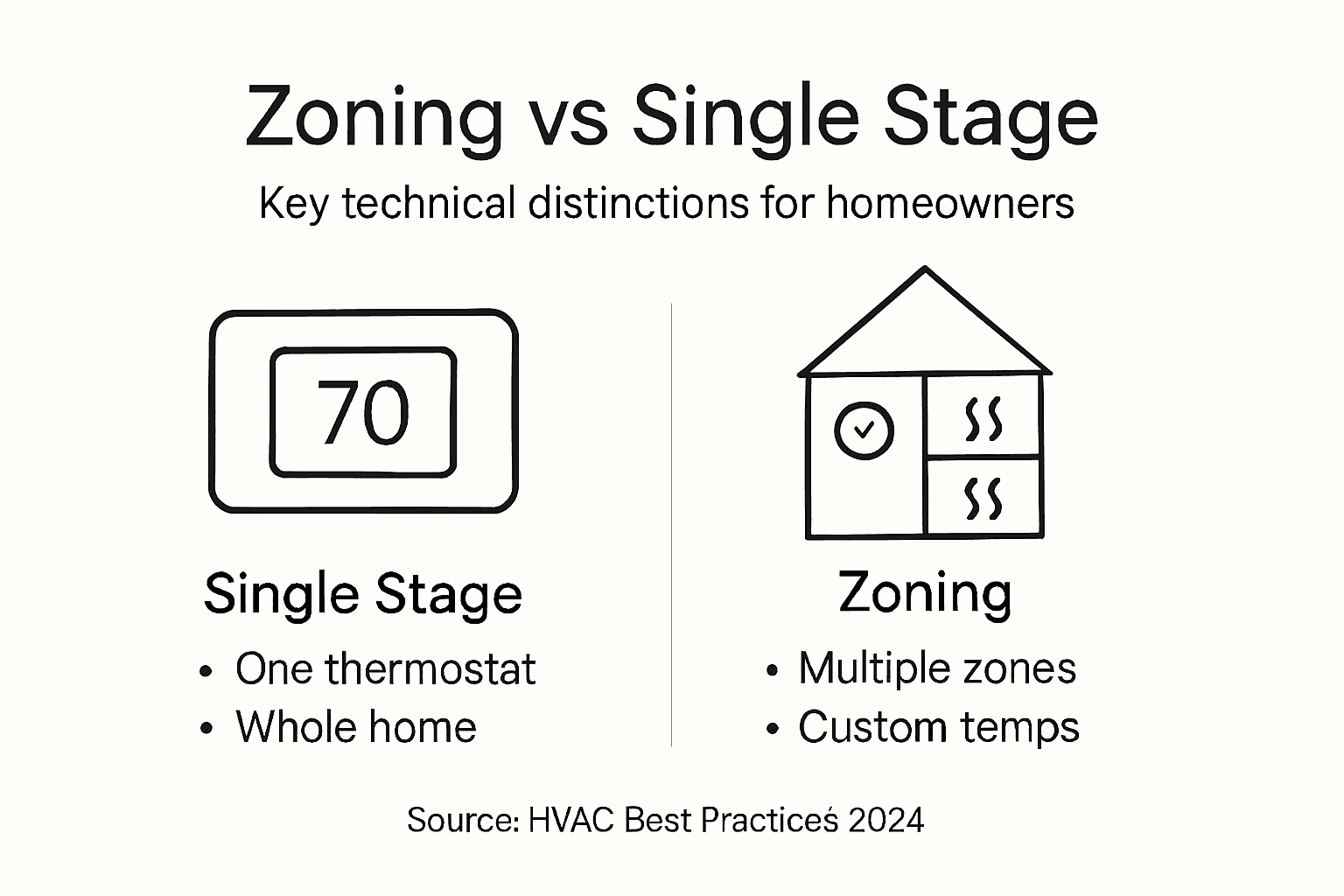
The technical difference between zoning and traditional single stage operation matters significantly for your installation approach. A traditional heat pump system has one thermostat sensing one location, triggering the entire system to run or stop. Zoned systems distribute temperature sensing across multiple areas, creating a feedback loop that adjusts operation zone by zone. This granular control is what enables both comfort improvements and energy savings. You might have one zone targeting your main living areas at 20°C while a second zone keeps bedrooms at 18°C, with a third zone in the basement set to 16°C. Each operates independently without compromising the others.
Pro tip: Start zoning installations by identifying high-variance areas in the home—south-facing rooms that gain excessive solar heat, basement spaces with inconsistent comfort, or upper floors that drift warmer than lower levels—and prioritize those as your initial zones to maximize customer satisfaction and measurable efficiency gains.
Comparing zoning system types and configurations
Not all zoning systems work the same way, and choosing the right configuration for your installation depends on the home’s layout, existing ductwork, and your client’s comfort priorities. You’ll encounter three primary configurations on the job: single-zone systems, multi-zone systems, and hybrid setups that blend traditional and modern approaches. Understanding these distinctions helps you recommend solutions that actually solve your customer’s problems rather than overselling unnecessary complexity. A cramped bungalow with an open concept layout has vastly different zoning needs than a sprawling two-storey home with isolated rooms and inconsistent temperature control.
Single-zone zoning represents the entry point for homeowners new to the concept. This configuration uses one controllable thermostat paired with dampers on a single duct branch or isolated room, allowing you to adjust temperature in that space while the rest of the home operates normally. Real-world example: a customer complains their master bedroom runs 3°C warmer than the living room. A single-zone setup with a damper on the bedroom’s supply duct and a dedicated thermostat solves this without major ductwork modifications. Installation complexity stays low, material costs remain reasonable, and your labour time stays minimal. However, single-zone systems lack the sophistication to balance demand across multiple problem areas simultaneously.
Multi-zone configurations expand this approach by dividing the home into three to five distinct zones, each with independent damper control and thermostat input. Different zoning system configurations offer varying flexibility depending on whether you’re working with retrofit installations or new construction. In a retrofit scenario, you’re constrained by existing ductwork, so you strategically zone the main supply lines feeding different areas. A new build allows you to design zones from scratch, routing ducts to support independent control from the start. Multi-zone systems deliver measurable comfort improvements across the entire home and generate substantial energy savings, typically 20 to 30 percent reductions in heating costs when properly configured. The tradeoff involves higher upfront material costs and more complex installation labour.
Hybrid setups and advanced configurations
Hybrid systems combine multi-zone distribution with selective damper control, allowing some zones to operate continuously while others activate on demand. This approach works exceptionally well in Canadian homes with basements. Your basement zone might run year-round at a minimal setpoint (say, 16°C) to prevent moisture and freeze damage, while upper-floor zones modulate based on occupancy and season. Another hybrid strategy pairs ducted distribution in primary living areas with ductless mini-split units in bedrooms or bonus rooms, creating a two-system approach that maximises both efficiency and control.
Feature comparison table
| Configuration | Installation Complexity | Retrofit Suitability | Energy Savings | Comfort Control | Material Cost |
|---|---|---|---|---|---|
| Single-zone | Low | Excellent | 5-10% | Limited | Low |
| Multi-zone | Moderate | Good | 20-30% | Excellent | Moderate |
| Hybrid ducted | Moderate to high | Good | 15-25% | Very good | Moderate to high |
| Hybrid mini-split | Moderate | Excellent | 10-20% | Excellent | Moderate |
The operational advantages shift based on your client’s situation. Retrofit projects in older homes with established ductwork benefit from multi-zone conversion because the infrastructure already exists. You’re simply adding damper actuators, a zone controller, and thermostats to existing ducts. New construction projects should incorporate zoning at the design phase, allowing architects and builders to size ducts and position branches strategically. Ductless mini-splits paired with a ducted primary system offer maximum flexibility for difficult layouts where running new ducts creates cost or structural barriers.
Pro tip: Assess ductwork condition and layout during your initial site visit before recommending a zoning configuration; poor ductwork design or leakage will undermine zoning benefits, so seal and balance ducts first, then layer zoning on top of a properly functioning system.
Designing residential zones for optimal performance
Designing zones that actually perform requires moving beyond generic room divisions and thinking strategically about how your client actually uses their home. The difference between a poorly designed zone layout and an optimised one can mean the difference between a satisfied customer and frustrated callbacks about inconsistent comfort. You need to consider occupancy patterns, thermal loads, insulation quality, and air distribution simultaneously. A home office that sits empty during work hours shouldn’t consume conditioning energy on the same thermostat as the living room where the family spends evenings. Similarly, a south-facing sunroom with single-pane windows has dramatically different heating and cooling loads than a north-facing bedroom with triple-glazed windows.
Start your zone design process by mapping actual usage patterns across the home. Walk through with your client and ask direct questions: which rooms are occupied during the day versus evening? Which spaces stay vacant for extended periods? Which rooms run consistently hot or cold regardless of season? Document this information because it becomes your zoning blueprint. A typical suburban home might follow a pattern where the main floor living, dining, and kitchen areas need active conditioning from 6 AM to 11 PM, while upstairs bedrooms only require conditioning from 10 PM to 7 AM. The basement workshop occupies perhaps 2 hours on weekends. This usage reality should drive your zone boundaries. Zoning design principles for residential heat pumps emphasize dividing spaces based on occupancy patterns and thermal characteristics to optimise system performance across varying household schedules.
Thermal load analysis matters as much as usage patterns. Sun exposure, insulation levels, window orientation, and external wall exposure all influence how quickly a zone heats or cools. Perform a quick manual assessment during your site visit:
- South and west-facing rooms gain significant solar heat in summer and lose heat rapidly in winter due to extended sun exposure
- North-facing spaces remain cooler year-round with minimal solar gain, reducing cooling loads but increasing heating demands
- Interior rooms without exterior walls experience minimal thermal swings compared to perimeter spaces
- Basement zones stay naturally cooler and benefit from lower setpoints, reducing conditioning runtime
- Upper floors typically run warmer due to heat stratification rising from lower levels
This thermal diversity is precisely why single-thermostat systems fail. A single setpoint cannot satisfy a south-facing master bedroom and a north-facing guest room simultaneously. Multi-zone design acknowledges these differences and allows independent control.
Air distribution and damper placement
Zone effectiveness depends entirely on proper air distribution. You cannot design zones without considering ductwork layout and damper positioning. Dampers should isolate zones at the branch level where ducts split from the main trunk line. Avoid placing dampers too close to the furnace or heat pump unit because this can create pressure imbalances that damage equipment or cause damper flutter. Position dampers at least 12 to 18 inches from any bends or transitions in the ductwork to ensure smooth airflow without turbulence.
When designing zones around existing ductwork, you’re often constrained by what’s already there. A home might have separate duct runs to upstairs and downstairs, which naturally defines two zones. You can then subdivide further by adding dampers on secondary branches feeding specific rooms or areas. In renovation scenarios where you’re installing new ductwork alongside a heat pump upgrade, design zones from scratch. Larger zones are preferable to extremely granular zones because each zone requires its own thermostat and damper actuator, adding cost and complexity. Most residential applications perform excellently with three to four well-designed zones rather than six or seven smaller ones.
Thermostat placement strategy
Where you position zone thermostats dramatically affects system performance. Each thermostat becomes the temperature sensing point for its entire zone, so placement matters. Position thermostats in occupied areas away from direct sunlight, exterior walls, supply registers, or return grilles. A thermostat sensing artificially warm air from a nearby supply register will trigger the system to shut down prematurely, leaving other parts of the zone under-conditioned. Mount thermostats at approximately 1.5 metres above the floor on an interior wall, in a central location representing the average temperature of that zone.
Pro tip: Design your zones around natural house divisions like separate floors, distinct wings, or areas separated by doors, rather than fragmenting single rooms; larger zones reduce equipment costs, simplify controls, and deliver 80 percent of the comfort benefits with a fraction of the complexity.
Installation, controls, and commissioning essentials
Proper installation and commissioning separate successful zoning systems from those that disappoint customers. You can design the perfect zone layout on paper, but if the installation misses critical details or commissioning skips verification steps, the system underperforms. This section covers the practical installation sequence, control system setup, and the commissioning procedures that ensure your zoned heat pump actually delivers the comfort and savings you promised.
Begin your installation by confirming that the heat pump unit itself is positioned correctly for your zoning approach. The outdoor compressor unit should sit away from windows, doors, and outdoor living areas to minimise noise transmission into conditioned spaces. Heat pump installation considerations include ensuring proper clearances around the compressor for adequate airflow and serviceability. Position indoor air handlers where they can distribute air effectively to all zones without creating excessive duct runs that reduce efficiency. In basement installations, elevate the unit on a pad to protect it from flooding during heavy spring runoff, a real concern across much of Canada.
Next, install damper actuators at precisely the locations you identified during design. Each actuator requires power wiring, so plan your electrical runs before drilling holes. Position motorised dampers on branch ducts feeding individual zones, not on the main trunk line. Mount dampers vertically when possible because horizontal dampers can stick due to gravity and vibration over time. Use metal damper frames that won’t flex or warp, and ensure the blade moves freely without binding. Test blade operation before sealing ductwork to catch any installation errors before they become hidden problems.
Control system wiring and thermostat installation
Your zone controller acts as the brain managing damper positions based on thermostat signals. This unit typically mounts inside the furnace cabinet or on an adjacent wall, connected to low-voltage wiring from each thermostat and each damper actuator. Run thermostat wiring through the same pathways as your damper actuator wiring to keep everything organised and protected from future renovations. Wire each zone thermostat independently back to the controller rather than daisy-chaining them together, which can cause communication issues.
Install thermostats after ductwork is sealed and the system has reached operational status. Mount each thermostat on an interior wall at about 1.5 metres height, away from direct sunlight, supply registers, and exterior walls. Test that each thermostat communicates properly with the zone controller before finishing wall surfaces. Many older homes have outdated mechanical thermostats designed for single-zone systems; upgrading to programmable or smart thermostats enables occupancy-based scheduling that maximises zoning benefits.
Commissioning and system verification
Commissioning is where you verify everything works as designed. Start by checking refrigerant charge using proper manifold gauges and ensuring superheat and subcooling readings fall within manufacturer specifications. Under-charged or over-charged systems cannot maintain proper cycling, reducing zoning effectiveness. Check airflow at the outdoor unit and indoor handler, verifying that the system is pulling adequate return air and delivering appropriate supply air temperature.
For zoning verification, test each zone independently:
- Set one zone to call for heating or cooling while setting others to neutral
- Verify that the corresponding damper opens and supply air flows to that zone
- Confirm that the zone thermostat is actually sensing temperature changes in its space
- Measure supply air temperature leaving the handler and return air temperature from each zone
- Verify that damper actuators respond smoothly without hesitation or noise
Run the system through a full heating cycle and a full cooling cycle, allowing adequate time between mode changes for pressures to stabilise. Check that the heat pump modulates smoothly rather than cycling on and off rapidly, which indicates improper zoning configuration or control settings. Document all measurements and thermostat setpoints in the customer’s commissioning report.
Pro tip: Create a detailed laminated commissioning checklist specific to each installation and tape it to the indoor unit; this reference guide helps you catch missed steps and gives the homeowner confidence that the system was properly verified before handoff.
Legal standards, code compliance, and technician roles
Heat pump zoning installations operate within a regulatory framework that varies by province, municipality, and local building codes. Your responsibility as an HVAC technician extends beyond technical competence to ensuring every installation meets legal standards and code requirements. Skipping compliance steps creates liability exposure for both you and your clients, and it can result in failed inspections, voided warranties, or insurance complications when problems arise. Understanding your jurisdictional requirements and your specific role in the installation process protects your reputation and your business.
Canadian provinces regulate HVAC work through different licensing frameworks. Some provinces require HVAC technicians to hold specific certifications or licences before installing heat pump systems, while others focus on electricians or gas technicians for certain components. Most Canadian jurisdictions require that trained HVAC technicians follow legal standards and safety codes to ensure proper heat pump installation. You need to verify your provincial regulatory requirements before taking on jobs. Ontario’s Department of Labour mandates specific training for anyone working with refrigeration systems, while British Columbia’s Building Code requires Licensed Practitioner approval. Alberta has similar requirements through Alberta Energy Regulator oversight. These are not minor paperwork requirements; they are legal obligations that shape how you can legally operate as an HVAC technician.
Building permit requirements vary significantly by municipality. Many Canadian cities require mechanical permits for heat pump installations because the system modifies your home’s heating and cooling infrastructure. A permit application typically requires technical drawings showing ductwork layout, zone configuration, damper placement, and electrical connections. Building inspectors verify that your installation follows code before granting final sign-off. Some jurisdictions have adopted the National Building Code of Canada with local modifications, while others maintain stricter standards for noise, setback distances, or seasonal operating restrictions. Toronto, Vancouver, and Montreal have distinct requirements even though all three are in provinces with similar provincial codes. Contact your local building department before designing your system to understand what documentation and inspections they require.
Refrigeration and electrical codes govern specific aspects of heat pump work. Refrigerant handling requires EPA (or Canadian equivalent) certification in most jurisdictions because improper handling releases ozone-depleting substances. Your zoning system includes low-voltage wiring and controls that must meet electrical code standards. In many provinces, a licensed electrician must complete final electrical connections, though HVAC technicians can prepare rough-in wiring. Check your local electrical authority’s requirements before assuming you can handle all wiring independently.
Your specific role and liability boundaries
Understand exactly what responsibilities fall to you versus other trades. HVAC technicians typically handle refrigeration charge, system balancing, ductwork installation, damper positioning, and initial thermostat configuration. Licensed electricians handle service panel connections and final electrical verification. Gas technicians handle any natural gas connections if a gas furnace remains in the system. Plumbers handle condensate drainage if required. Clearly defining boundaries with other trades prevents gaps where code requirements fall through the cracks.
Document everything you do during installation and commissioning. Photograph ductwork before sealing it, record refrigerant charge details, document thermostat setpoints, and keep written commissioning records. This documentation proves you followed code if a building inspector questions your work, and it protects you if a dispute arises later about system performance.
Use this table as a quick reference for technician responsibilities during zoning projects:
| Task | Responsible Trade | Key Documentation |
|---|---|---|
| Ductwork & damper install | HVAC technician | Duct layout photos |
| Electrical connections | Licensed electrician | Permit sign-off sheet |
| Thermostat configuration | HVAC technician | Zone setpoint log |
| Refrigerant charging | HVAC technician | Pressure test report |
| Condensate drain install | Plumber | Inspection approval |
Pro tip: Contact your municipal building department at the project planning stage, not after installation begins; this early conversation clarifies permit requirements, inspection schedules, and specific code amendments that affect your design, saving costly rework and preventing project delays.
Common zoning errors and cost-saving opportunities
Most zoning installations underperform because of preventable mistakes made during design or installation. You see the same errors repeatedly across different homes and contractors, which means recognising and avoiding them becomes a competitive advantage. Customers paying for zoning expect results, and when systems underdeliver, you lose credibility and face callbacks that erode profitability. Understanding common pitfalls helps you deliver systems that actually satisfy customers and demonstrate measurable savings.
The most frequent zoning error involves creating zones that are too small or too granular. A technician looks at a home and thinks, “I can zone every bedroom separately, plus the living room, plus the basement.” What sounds comprehensive on paper becomes a maintenance nightmare in reality. Each zone requires its own thermostat, damper actuator, and control logic. You’ve multiplied complexity, increased material costs, and created more components that can fail. A customer with seven zones now has seven thermostats generating seven different comfort complaints. The system becomes harder to balance and commission because airflow constraints multiply when you split supply into too many branches. The practical solution: design three to four strategic zones instead of six or seven. Avoiding improper zone sizing and focusing on occupant behaviour patterns yields better results with lower installation and maintenance costs. Larger zones are inherently more forgiving and easier to commission successfully.
Thermostat placement mistakes undermine zoning effectiveness more often than you might expect. A thermostat positioned in direct sunlight reads 2 to 3 degrees warmer than the actual zone temperature, causing the system to shut down prematurely. A thermostat mounted inches from a supply register senses warm air and stops the heat pump before the rest of the zone reaches setpoint. A thermostat in a rarely occupied closet senses conditions that don’t represent actual living space temperature. Each of these mistakes means the zone doesn’t maintain setpoint and the customer perceives poor performance. Mount thermostats centrally in occupied spaces, away from sun exposure, exterior walls, and supply or return air streams. Test thermostat locations before final installation by holding a thermometer in different spots and watching how temperature varies across the zone.
Ductwork and airflow imbalances
Poor ductwork design creates zoning failure even when the control system works perfectly. Undersized ducts feeding a particular zone create resistance that starves that area of conditioned air. Uninsulated ducts running through unconditioned spaces lose temperature, so supply air arriving at the zone is warmer or cooler than it should be. Leaky ducts waste conditioned air, reducing system capacity and increasing runtime. Before adding zoning to an existing system, seal ductwork leaks and verify adequate airflow. Some technicians skip this step to save time, which creates a zoning system that cannot deliver on its promises. The return air path matters equally. Blocked return air forces the system to work harder and prevents proper pressure balance across zones.
Cost-saving opportunities emerge when you approach zoning strategically. Retrofit projects in homes with poor attic insulation benefit more from insulation upgrades than from zoning alone. A customer spending money on zoning while losing heat through an under-insulated attic misses the primary efficiency opportunity. Recommend a layered approach: seal and balance ducts first, upgrade insulation and weatherstripping second, then add zoning third. Zone-specific heating and cooling optimisation delivers maximum savings when the building envelope is already reasonably efficient.
Below is a summary table illustrating common zoning system mistakes and their impact:
| Mistake Type | Potential Impact | Long-term Consequence |
|---|---|---|
| Oversized zone count | High complexity, more equipment | Higher maintenance costs |
| Poor thermostat placement | Inaccurate temperature control | Uneven comfort, customer complaints |
| Ignored duct issues | Inadequate airflow to zones | Reduced energy savings, system strain |
| Skipping insulation upgrade | Persistent heat/cool loss | Missed efficiency, higher bills |
Smart thermostat integration amplifies zoning benefits without proportional cost increases. Programming zones to reduce conditioning in unoccupied times captures 10 to 15 percent additional savings over static setpoints. A zone setback strategy that lowers unoccupied bedrooms to 16°C during winter nights and raises them to 22°C only before occupants wake saves energy versus maintaining 20°C continuously. These scheduling opportunities cost minimal additional labour to implement but compound into substantial annual savings.
Pro tip: During your initial site assessment, photograph ductwork leaks and insulation deficiencies before recommending zoning, then present a prioritised upgrade path that addresses envelope and ductwork issues before zoning controls, positioning you as someone solving the customer’s actual efficiency problem rather than just installing equipment.
Enhance Your Home Comfort and Cut Energy Costs with Expert Heat Pump Zoning
Struggling with uneven temperatures in your home or high heating bills despite your heat pump system? The article highlights how heat pump zoning improves comfort by directing conditioned air only where it is needed, dramatically reducing energy waste. At CoolFix, we understand these challenges and offer professional heat pump installation and repair services tailored to maximize your system’s efficiency through smart zoning solutions. By integrating precise zone controls, dampers, and thermostats, you can enjoy consistent comfort in every room without overspending.

Take control of your indoor climate today with CoolFix’s proven expertise. Our team ensures your heat pump zoning system is expertly designed, installed, and commissioned for optimal performance. Don’t let poor ductwork or thermostat placement undermine your savings—visit CoolFix now to schedule an assessment and discover how zoning can transform your home’s heating and cooling efficiency with lasting results.
Frequently Asked Questions
What is heat pump zoning?
Heat pump zoning is a method that divides your heating and cooling system into separate areas, or zones, allowing different parts of your home to maintain different temperatures based on occupancy and comfort needs.
How does zoning improve the efficiency of a heat pump system?
Zoning improves efficiency by directing conditioned air only to occupied spaces, reducing the runtime of the heat pump. This can lead to significant cost savings on energy bills, as the system runs less often and focuses on where it’s needed most.
What are the main components of a heat pump zoning system?
A heat pump zoning system typically consists of three main components: thermostat control to manage temperatures in each zone independently, damper actuators to regulate airflow, and a zone controller that coordinates the entire system based on thermostat signals.
How do I determine the best zoning configuration for my home?
To determine the best zoning configuration, consider the layout of your home, existing ductwork, and occupancy patterns. Identify rooms with varying temperature demands and prioritize these areas to create zones that optimize comfort and efficiency.
Recommended
- Cost of a Central Air Conditioner for a 1200ft² Home –
- Choosing the Right HVAC Contractor for You
- Articles – CoolFix Appliance & HVAC Service
- HVAC Services – CoolFix Appliance & HVAC Service
- HVAC Zoning System Installation for Home Comfort – Home Therapist Cooling, Heating, and Plumbing
- Understanding What is an Air to Air Heat Pump – Skan Plumbing & Heating
0 Comments