

TL;DR:
- Routine heat pump checks save homeowners around 15% on energy bills by optimizing system performance.
- Regular inspections prevent costly breakdowns by addressing issues like defrost failures, refrigerant levels, and controller settings.
- Scheduling annual maintenance in spring or autumn is cost-effective and helps maintain system efficiency throughout the year.
Most homeowners assume a heat pump that’s running is a heat pump that’s working well. That assumption is quietly costing them hundreds of dollars every year. A field study of 1,023 heat pumps found that optimisations to poorly configured systems yielded 15.2% energy savings, equal to 1,805 kWh per year. That’s not a small number. Across a Canadian winter, those wasted kilowatt-hours add up fast. This article walks you through what routine checks actually involve, how they protect your budget, and why skipping them is one of the most expensive habits a homeowner can have.
Table of Contents
- What routine heat pump checks involve
- Efficiency and energy savings: the hidden payback
- Preventing breakdowns and extending heat pump life
- How to time and budget routine checks for peace of mind
- Why most homeowners underestimate the value of routine checks
- Get expert help for your heat pump today
- Frequently asked questions
Key Takeaways
| Point | Details |
|---|---|
| Routine checks prevent failures | Regular heat pump maintenance catches issues early and helps avoid costly breakdowns. |
| Save on energy bills | Homeowners can boost efficiency and shave up to 15% off energy costs with routine inspections. |
| Extend heat pump lifespan | Scheduled checks directly lengthen the useful life of your heat pump, postponing expensive replacements. |
| Peace of mind through planning | Annual maintenance provides confidence and predictable comfort in all Canadian seasons. |
What routine heat pump checks involve
A routine heat pump check is a structured inspection carried out by a qualified technician, covering every major component of your system. It is not a quick glance at the unit. Think of it the way you think about a car service: you might not feel anything wrong, but the mechanic finds the worn brake pad before it becomes a blown tyre. The same logic applies here.
During a proper inspection, the technician examines both the indoor air handler and the outdoor unit, checks electrical connections, verifies refrigerant levels, tests the defrost cycle, and reviews controller settings. Each of these tasks targets a specific failure point that homeowners rarely notice on their own.
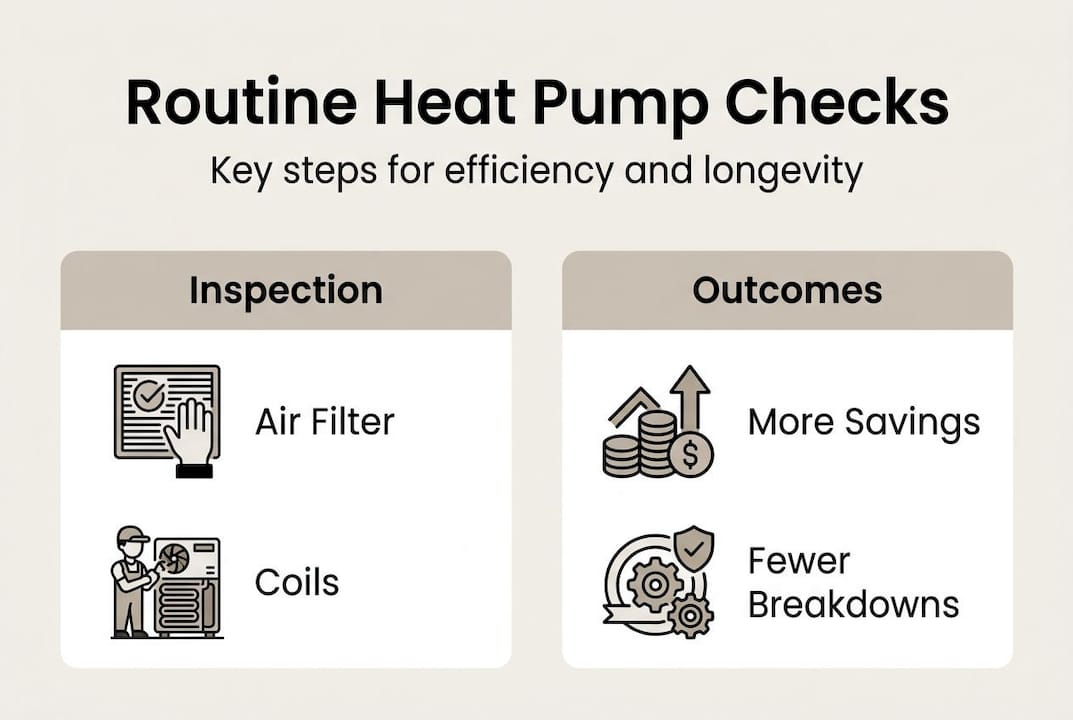
For Canadian homes, the defrost cycle deserves special attention. Defrost cycle failure is critical in cold climates because the outdoor coil can ice over when temperatures drop below 35°F. Once that happens, your system works harder, uses more energy, and can sustain compressor damage. Oversized systems, which account for roughly 10% of installations, also short-cycle, meaning they turn on and off too frequently, wearing out components faster than normal.
Pro Tip: Ask your technician to check your controller settings specifically. Poor controller settings are one of the most common problems found in existing buildings, yet they take only minutes to correct and can meaningfully cut your energy use.
Here is a quick look at what a solid routine inspection covers:
- Indoor coil and air filter condition
- Outdoor unit clearance and coil cleanliness
- Refrigerant pressure and charge level
- Electrical connections and capacitor condition
- Defrost cycle operation and timing
- Controller and thermostat settings
- Blower motor and fan blade condition
| Inspection task | Problem it targets |
|---|---|
| Filter and coil cleaning | Restricted airflow and efficiency loss |
| Refrigerant check | Undercharge causing poor heating or cooling |
| Defrost cycle test | Ice build-up and compressor strain |
| Controller settings review | Energy waste from incorrect programming |
| Electrical inspection | Wiring faults and safety risks |
| Sizing assessment | Short-cycling from oversized equipment |
Understanding routine heat pump maintenance gives you a clear picture of what you’re paying for and why it matters. If you’re already noticing odd behaviour, reviewing common heat pump repair signs can help you decide whether a check is overdue.
Efficiency and energy savings: the hidden payback
Here’s something most homeowners don’t realise: your heat pump can lose efficiency gradually, without ever throwing an error code or making a strange noise. The system keeps running. Your bills keep climbing. And you keep assuming everything is fine.
Field data tells a different story. Optimisations across 1,023 heat pumps produced average energy savings of 15.2%, or 1,805 kWh per year. That’s roughly equivalent to running your refrigerator for an entire year, for free, just by correcting settings and cleaning components.

One of the most powerful levers is the heating curve setting. Long-term field studies of 840+ heat pumps show that correct heating curve settings improve the Seasonal Performance Factor (SPF) by approximately 0.1 for every 1°C reduction in the target temperature. SPF is the ratio of heat delivered to electricity used. A higher SPF means you get more warmth for every dollar spent.
| Scenario | Annual energy use (kWh) | Estimated annual cost (at $0.15/kWh) |
|---|---|---|
| No routine checks | ~13,500 | ~$2,025 |
| Annual routine checks | ~11,700 | ~$1,755 |
| Potential savings | ~1,800 | ~$270 |
The biggest energy-wasting mistakes that routine checks catch include:
- Heating curve set too high, forcing the system to overheat the home
- Dirty coils reducing heat transfer efficiency
- Low refrigerant charge making the compressor work overtime
- Incorrect thermostat scheduling running the system when no one is home
- Blocked outdoor unit reducing airflow and performance
These are not exotic problems. They show up in ordinary homes across Canada every season. Applying energy saving tips for heat pumps between professional visits helps, but nothing replaces a trained eye on the actual components. For a deeper look at how the numbers work, heat pump efficiency explained breaks down SPF and related metrics in plain language.
Preventing breakdowns and extending heat pump life
A heat pump that breaks down in January is not just an inconvenience. It’s an emergency. Emergency service calls cost significantly more than scheduled maintenance, and if a major component like the compressor fails, you could be looking at a repair bill that rivals a new installation.
Routine checks stop most common failure causes before they escalate. Here’s how that works in practice:
- Cleaning coils and filters keeps airflow unrestricted, reducing the strain on the blower motor and compressor, both of which wear out faster under load.
- Verifying refrigerant levels prevents the compressor from running in an undercharged state, which is one of the leading causes of premature compressor failure.
- Testing the defrost cycle ensures the outdoor coil doesn’t ice over during cold snaps, protecting the compressor from the mechanical stress of trying to push refrigerant through a frozen system.
- Reviewing controller and sizing settings catches short-cycling early. As the data shows, oversized systems short-cycle in roughly 10% of installations, and each unnecessary start-stop cycle adds wear to the compressor and electrical components.
“Routine checks catch sizing mismatches that cause short-cycling in 10% of systems, preventing years of unnecessary wear on compressors and electrical components.”
Pro Tip: In Canada, the defrost cycle is your system’s first line of defence against winter damage. If your technician doesn’t specifically test defrost operation during a cold-weather visit, ask them to. It’s a five-minute check that can prevent a multi-thousand-dollar repair.
Understanding why heat pumps fail gives you a clearer picture of the risks involved in skipping checks. If you want to get the most years out of your equipment, the guidance on extending heat pump life outlines the specific steps that make the biggest difference.
How to time and budget routine checks for peace of mind
Knowing that routine checks matter is one thing. Actually scheduling them is another. Most Canadian homeowners put it off because they’re not sure when to book, what it costs, or what questions to ask. Let’s make that easy.
The best time to schedule a routine check in Canada is in the spring, before the cooling season begins, or in early autumn, before you rely on the system for heating. Booking during these shoulder seasons also means technicians are more available and scheduling is easier than during peak demand in January or July.
Poorly configured systems account for 17% of heat pumps that fail efficiency standards, which means nearly one in five systems is underperforming right now, often without the homeowner knowing. Annual checks are the most reliable way to stay out of that group.
| Cost comparison | Estimated amount (CAD) |
|---|---|
| Annual routine maintenance | $150 to $300 |
| Single emergency repair call | $300 to $800 |
| Compressor replacement | $1,200 to $2,500 |
| Full heat pump replacement | $5,000 to $15,000 |
The math is straightforward. One annual visit costs less than a single emergency call, and far less than a compressor or full replacement.
When you speak to a service professional, ask these questions:
- Do you test the defrost cycle as part of your inspection?
- Will you review and adjust my controller settings?
- Can you check whether my system is correctly sized for my home?
- Do you provide a written inspection report?
Regular heat pump cleaning between professional visits keeps the system in better shape year-round. If you’re curious about what a technician’s full process looks like, the maintenance workflow guide walks through each step in detail.
Why most homeowners underestimate the value of routine checks
After years of working with heat pump systems, one pattern stands out clearly: homeowners skip routine checks not because they don’t care, but because the problems are invisible. A dirty coil doesn’t announce itself. A misconfigured heating curve doesn’t trigger an alarm. The system just quietly uses more electricity and delivers slightly less comfort, month after month.
Most heat pumps lose efficiency so gradually that the change never registers as a problem. It just feels like a slightly higher bill, or a room that takes a bit longer to warm up. By the time something obvious breaks, the system has often been underperforming for years.
What fieldwork consistently reveals is that wiring faults and settings errors go unnoticed in ordinary homes for a very long time. These are not dramatic failures. They are quiet drains. The expensive surprises, the compressor that dies on the coldest night of the year, almost always have a history of small, missed warning signs behind them.
Understanding why maintenance gets ignored is the first step to breaking the pattern. Pro Tip: Ask your technician to show you their inspection sheet after the visit. Seeing the actual checklist items, and what was adjusted, makes the value of the visit concrete and builds trust in the process.
Get expert help for your heat pump today
Ready to put your peace of mind on autopilot? Routine heat pump checks are one of the simplest ways to lower your energy bills and avoid the stress of unexpected breakdowns. CoolFix specialises in expert heat pump maintenance and appliance repair, helping Canadian homeowners get the most out of their systems year after year.

Whether you’re planning an upgrade, navigating a new installation, or just want to know your system is running at its best, CoolFix has the expertise to help. Explore the heat pump replacement guide if you’re weighing your options, review install heat pump best practices before any new work begins, or browse appliance repair tips to find the right professional for your needs. Book a checkup today and stop leaving money on the table.
Frequently asked questions
How often should I schedule routine heat pump checks in Canada?
Experts recommend annual checks, ideally before heating or cooling season. 17% of heat pumps fail efficiency standards due to poor settings, making yearly inspections essential for reliable performance.
Can routine maintenance really improve energy savings?
Yes. Studies show that routine adjustments produce 15.2% energy savings, equal to roughly 1,805 kWh per year, which translates directly to lower monthly bills.
What are the most common problems found in routine heat pump checks?
The most frequent issues are incorrect controller settings, defrost cycle failures in cold weather, and short-cycling from oversized systems, all of which are easy to correct when caught early.
How much does routine heat pump maintenance typically cost?
Annual routine maintenance in Canada usually costs between $150 and $300, which is far less than the cost of emergency repairs or a full system replacement.
Recommended
- Why perform routine heat pump maintenance: save 25% energy – CoolFix Appliance & HVAC Service
- Top ways to extend heat pump life and prevent costly repairs | CoolFix Appliance & HVAC Service
- Why heat pump cleaning boosts efficiency by up to 25% | CoolFix Appliance & HVAC Service
- Optimized Heat Pump Maintenance Workflow for Technicians – CoolFix Appliance & HVAC Service
0 Comments