

Many Canadian homeowners worry that heat pumps won’t keep them warm during harsh winters. Modern cold-climate heat pumps actually deliver reliable heating down to -15°C and beyond, making them a practical choice even in frigid conditions. With rising energy costs and ambitious climate goals pushing Canada toward cleaner solutions, understanding how heat pumps work and what they offer has never been more relevant for homeowners evaluating efficient heating options.
Table of Contents
- Introduction To Heat Pumps And Their Growing Popularity In Canada
- How Heat Pumps Work And Adapt To Canadian Climate Conditions
- Energy Efficiency, Environmental Benefits, And Cost Savings
- Common Misconceptions About Heat Pump Performance In Cold Weather
- Comparing Heat Pumps With Traditional Heating Systems
- Installation Best Practices, Maintenance, And Longevity
- Conclusion: Making An Informed Decision For Your Home
- Are Heat Pumps Effective In Extremely Cold Canadian Winters?
Key takeaways
| Point | Details |
|---|---|
| Cold weather reliability | Modern heat pumps maintain efficient heating down to -15°C, with backup options for colder spells. |
| Energy savings | Heat pumps reduce heating energy demand by over 50% compared to electric baseboards and cut carbon emissions significantly. |
| Financial incentives | Government rebates can lower installation costs by thousands of dollars across Canadian provinces. |
| Dual functionality | A single heat pump system provides both heating and cooling year-round for complete home comfort. |
| Long-term value | With proper installation and maintenance, heat pumps deliver 15-20 years of reliable, efficient service. |
Introduction to heat pumps and their growing popularity in Canada
Heat pumps represent a fundamentally different approach to home comfort. Instead of burning fuel or using electric resistance to create heat, they transfer existing thermal energy from outside air into your home during winter and reverse the process for cooling in summer. This transfer method makes them remarkably efficient, delivering multiple units of heat for every unit of electricity consumed.
Canadian adoption is accelerating rapidly. Rising natural gas and electricity costs make efficient heating solutions increasingly attractive to homeowners. Meanwhile, federal and provincial governments are targeting net-zero emissions by 2050, creating policies and incentives that support heat pump installation cost Canada reductions and encourage homeowners to switch from fossil fuel systems. The increasing adoption driven by climate goals reflects both economic and environmental motivations.
Key factors driving heat pump popularity include:
- Dual heating and cooling capability eliminates the need for separate systems
- Lower operating costs compared to traditional electric or fossil fuel heating
- Reduced carbon footprint aligning with personal and national climate commitments
- Improved cold-climate technology addressing Canadian winter concerns
- Substantial government rebates offsetting initial investment barriers
The combination of technological advances and policy support creates an ideal moment for Canadian homeowners to consider heat pumps seriously. Understanding exactly how these systems function in cold conditions helps homeowners make confident decisions.
How heat pumps work and adapt to Canadian climate conditions
The basic heat pump operation relies on refrigerant循ating through outdoor and indoor coils. Even when outdoor temperatures feel freezing to us, thermal energy still exists in the air. The outdoor unit extracts this energy, compresses the refrigerant to increase temperature, then releases that warmth inside your home through the indoor unit. During summer, the cycle reverses to provide air conditioning.
Cold-climate models incorporate advanced features specifically designed for harsh Canadian winters:
- Variable-speed compressors adjust output smoothly rather than cycling on and off, maintaining consistent temperatures while optimising efficiency.
- Enhanced vapour injection technology boosts heating capacity at lower outdoor temperatures, extending effective operation range.
- Smart defrost systems monitor coil conditions and activate defrost cycles only when needed, preventing ice buildup without wasting energy.
- Improved insulation and weatherisation of outdoor units protect components from extreme cold.
- Larger coil surface areas in outdoor units maximise heat extraction even when ambient temperatures drop significantly.
Modern cold-climate heat pumps maintain efficiency down to -15°C through these technological improvements. Some premium models continue operating effectively to -25°C or lower, though efficiency gradually decreases as temperatures fall. For regions experiencing frequent extreme cold below -25°C, pairing your heat pump with supplementary electric resistance heating or retaining an existing backup system ensures comfort during the coldest days.
Pro Tip: When selecting a heat pump for Canadian climates, look for models with a Heating Seasonal Performance Factor rating of 10 or higher and verify the manufacturer specifies cold-climate capability with tested performance data at -15°C and below.
Proper sizing matters enormously. An undersized unit struggles to maintain comfort during cold snaps, while an oversized system cycles too frequently, reducing efficiency and component lifespan. Professional heat load calculations account for your home’s insulation, air sealing, window quality, and regional climate to determine optimal capacity.
Energy efficiency, environmental benefits, and cost savings
Heat pumps excel at converting electricity into home heating. For every kilowatt-hour of electricity consumed, they can deliver two to four kilowatt-hours of heating energy. This efficiency translates directly into lower utility bills compared to electric baseboards, which convert electricity to heat at a 1:1 ratio, or natural gas furnaces, which lose significant energy through combustion exhaust.
The financial advantages compound over time:
- Typical Canadian households reduce heating energy demand by more than 50% after switching from electric resistance or older furnaces
- Annual heating cost savings range from $500 to $1,500 depending on previous system type and local electricity rates
- Eliminating separate cooling systems reduces both equipment and maintenance expenses
- Government rebates through programs like Canada Greener Homes can cover $5,000 or more of heat pump installation cost Canada
| System Type | Annual Energy Cost | Carbon Emissions | Efficiency Rating |
|---|---|---|---|
| Heat Pump | $800-$1,200 | 1.5 tonnes CO₂ | 300-400% |
| Natural Gas Furnace | $1,100-$1,600 | 4.2 tonnes CO₂ | 80-95% |
| Electric Baseboard | $1,800-$2,400 | 2.8 tonnes CO₂ | 100% |
| Oil Furnace | $2,000-$2,800 | 6.5 tonnes CO₂ | 70-85% |
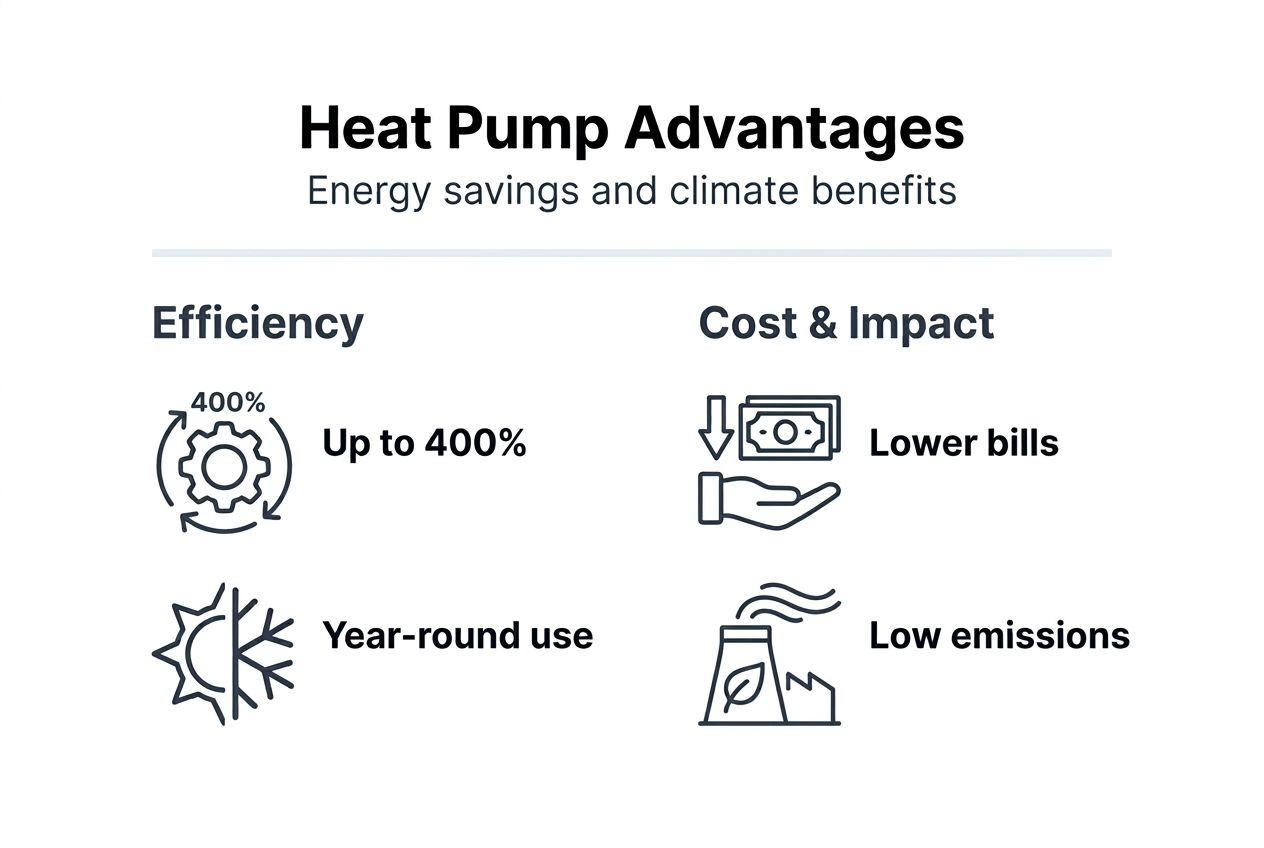
Environmental benefits extend beyond personal savings. Heat pumps dramatically lower household carbon footprints, particularly as provincial electricity grids incorporate more renewable generation. A typical home switching from natural gas to a heat pump reduces greenhouse gas emissions by approximately 2.7 tonnes annually. Scaled across millions of Canadian homes, this transition represents a critical pathway toward national climate targets.
Pro Tip: Maximise your savings by applying for federal, provincial, and potentially municipal rebates simultaneously. Many programs stack, and certified installers can help navigate available incentives to reduce your net cost substantially.
The initial investment ranges from $10,000 to $20,000 depending on system capacity, model features, and installation complexity. While higher than traditional furnaces, the combination of energy savings and rebates often achieves payback within 7-10 years. Given the 15-20 year typical lifespan, homeowners enjoy a decade or more of pure savings.
Common misconceptions about heat pump performance in cold weather
Several persistent myths discourage homeowners from considering heat pumps. Addressing these misunderstandings helps clarify what modern systems actually deliver.
Myth: Heat pumps stop working entirely when temperatures drop below -10°C. Reality: Modern cold-climate models maintain heating capacity to -15°C and continue operating at reduced efficiency even colder. Pairing with backup heating handles extreme cold snaps without comfort loss.
Myth: Heat pumps only provide heating or only provide cooling. Reality: Every heat pump offers both functions through reversible operation. You get year-round comfort from one system rather than maintaining separate heating and cooling equipment.
Myth: Heat pumps are too expensive for average homeowners. Reality: Government rebates significantly reduce upfront costs, while energy savings provide ongoing financial benefits that traditional systems cannot match.
Myth: Heat pumps require constant expensive maintenance. Reality: Annual professional servicing plus simple homeowner tasks like filter cleaning constitute typical maintenance, comparable to furnace upkeep.
Key considerations for cold climate success:
- Selecting equipment specifically rated for cold climate operation rather than standard models
- Ensuring proper installation with correct refrigerant charge and airflow settings
- Maintaining realistic expectations about backup heating needs during extreme cold events
- Understanding that heat pumps deliver steady, consistent warmth rather than the intense blast some furnaces produce
Homeowners sometimes conflate older heat pump limitations with current technology capabilities. Equipment from even five years ago lagged considerably behind today’s cold-climate models in low-temperature performance. Recent advances make heat pumps genuinely practical across most Canadian regions, including provinces experiencing regular winter cold.
Comparing heat pumps with traditional heating systems
Understanding how heat pumps stack up against established heating options helps homeowners evaluate whether switching makes sense for their situation and budget.
Efficiency comparison reveals dramatic differences. Heat pumps achieve 300-400% efficiency by moving heat rather than creating it. Electric baseboards operate at exactly 100% efficiency, converting every watt of electricity directly to heat but offering no multiplier effect. Natural gas furnaces reach 80-95% efficiency, losing 5-20% of fuel energy through exhaust. Oil furnaces typically achieve only 70-85% efficiency with higher emissions and fuel costs.
| Factor | Heat Pump | Natural Gas Furnace | Electric Baseboard | Oil Furnace |
|---|---|---|---|---|
| Efficiency | 300-400% | 80-95% | 100% | 70-85% |
| Heating & Cooling | Both | Heating only | Heating only | Heating only |
| Carbon Emissions | Low | Moderate | Low-Moderate | High |
| Operating Cost | Lowest | Moderate | High | Highest |
| Upfront Cost | High | Moderate | Low | Moderate |
Cost analysis shows heat pumps winning long-term despite higher initial investment. A typical heat pump cost comparison Canada reveals $10,000-$20,000 installation versus $4,000-$8,000 for gas furnaces or $2,000-$4,000 for electric baseboards. However, annual operating savings of $800-$1,500 mean heat pumps often achieve payback within a decade.
Comfort characteristics differ noticeably. Heat pumps deliver consistent temperatures through continuous low-level operation rather than cycling between intense heating bursts and off periods. This steady approach eliminates temperature swings and cold spots common with traditional systems. Many homeowners report improved comfort alongside energy savings.
Environmental impact considerations matter increasingly to Canadian homeowners. Heat pumps eliminate direct fossil fuel combustion at your home, shifting emissions to centralized power generation where efficiency and pollution controls work better. As electricity grids incorporate more renewable sources, heat pump environmental benefits continue improving over their operating lifetime.
Operational differences include noise levels and maintenance patterns. Modern heat pumps typically run quieter than older furnaces, though outdoor unit placement affects perceived noise. Both systems require annual professional maintenance, but heat pumps need attention to refrigerant systems and defrost cycles rather than combustion components.
Installation best practices, maintenance, and longevity
Proper installation fundamentally determines whether your heat pump delivers promised performance and efficiency. Selecting qualified professionals and following best practices protects your investment.
Certified installers bring essential expertise. Look for technicians with specific heat pump training and certification rather than general HVAC experience alone. They should perform detailed heat load calculations for your home, considering insulation levels, air sealing quality, window efficiency, and local climate data. These calculations determine correct system sizing, preventing the efficiency and comfort problems that plague oversized or undersized installations.
Critical installation elements include:
- Proper outdoor unit placement ensuring adequate airflow and protection from prevailing winds
- Correct refrigerant charge verified through precise measurement rather than estimation
- Indoor unit location optimising air distribution throughout your home
- Electrical service verification and potential upgrades to handle system requirements
- Condensate drainage routing preventing ice buildup during winter operation
Pro Tip: Request documentation of the heat load calculation and refrigerant charge verification. Professional installers readily provide this information, while less qualified contractors may skip these crucial steps.
Avoiding heat pump installation mistakes starts with recognising common errors like improper sizing, inadequate electrical supply, poor outdoor unit placement, or incorrect refrigerant levels. These problems reduce efficiency, shorten equipment life, and compromise comfort.
Maintenance requirements preserve your system investment. Professional servicing every 12-24 months should include refrigerant level checks, electrical connection inspection, defrost system testing, and indoor coil cleaning. Homeowners contribute by cleaning or replacing filters monthly during heavy use seasons and keeping outdoor units clear of debris, snow, and ice.
Expected lifespan reaches 15-20 years with proper installation and ongoing maintenance. This longevity matches or exceeds traditional heating systems. Component warranties typically cover 5-10 years for parts, with compressors often warranted longer as the most expensive element.
Regular professional maintenance not only extends equipment life but maintains peak efficiency, ensuring you continue realising maximum energy savings throughout your heat pump’s service life.
Common repairs include refrigerant leak fixes, defrost sensor replacements, fan motor servicing, and control board updates. Addressing issues promptly prevents minor problems from cascading into expensive failures. Understanding why heat pumps need servicing helps homeowners maintain their systems properly and recognise when professional attention becomes necessary.
Conclusion: making an informed decision for your home
Heat pumps offer Canadian homeowners a proven pathway to lower energy costs, reduced carbon footprints, and reliable year-round comfort. Modern cold-climate technology addresses winter performance concerns that historically limited adoption. Government rebates make the financial equation increasingly attractive, offsetting higher upfront costs through both incentives and ongoing savings.
Your decision should weigh initial investment against long-term benefits, consider your home’s specific heating requirements and existing infrastructure, and factor in available provincial and federal rebates. Choosing certified installers ensures proper sizing and installation, maximising performance and longevity. With realistic expectations about backup heating during extreme cold and commitment to regular maintenance, heat pumps deliver efficient, comfortable, and environmentally responsible home heating and cooling for decades.
Are heat pumps effective in extremely cold Canadian winters?
Are heat pumps effective in extremely cold Canadian winters?
Modern cold-climate heat pumps maintain efficient heating down to approximately -15°C through advanced compressor technology and enhanced refrigerant systems. For regions experiencing frequent temperatures below -25°C, pairing your heat pump with backup electric resistance heating or retaining an existing supplementary system ensures comfort during the coldest periods. Proper model selection rated specifically for cold climates is essential for reliable winter performance.
What kind of maintenance does a heat pump require in Canada?
Annual or biennial professional servicing should include refrigerant level verification, defrost system inspection, electrical connection checks, and coil cleaning. Homeowners contribute by replacing or cleaning filters monthly during peak heating and cooling seasons, keeping outdoor units clear of snow, ice, leaves, and debris, and monitoring system performance for unusual sounds or reduced comfort. This regular attention extends system lifespan and preserves efficiency.
Can I qualify for government rebates when installing a heat pump?
Most Canadian provinces offer substantial rebates through programs like Canada Greener Homes, provincial efficiency initiatives, and sometimes municipal incentives. Total available rebates can reach $5,000 to $7,000 or more depending on your location, equipment efficiency ratings, and installation details. Eligibility typically requires using certified installers and selecting qualifying equipment models, so verify program requirements before purchasing.
Are heat pumps noisy when operating?
Modern heat pumps operate quietly, typically producing 50-60 decibels comparable to normal conversation levels and often quieter than traditional furnaces. Outdoor unit placement away from bedroom windows and neighbouring properties minimises any noise impact. Variable-speed models run especially quietly because they avoid the jarring on/off cycling of single-stage systems. Proper installation with vibration-dampening mounting further reduces operational sound.
Looking for expert heat pump installation?
Choosing the right heat pump and ensuring proper installation requires professional expertise. Our certified technicians specialise in heat pump installation across Canada, helping homeowners select appropriate systems and maximise available rebates.

We provide comprehensive heat load calculations, cold-climate model recommendations, and complete installation services backed by manufacturer warranties and our workmanship guarantee. Our team stays current on evolving technology and government incentive programs, ensuring you benefit from the latest advances and financial support. From initial consultation through ongoing maintenance, we guide you toward efficient, reliable home comfort that reduces energy costs and environmental impact for decades. Contact us to discuss whether a heat pump suits your home and how we can help you transition to cleaner, more efficient heating and cooling.
Recommended
- Heat Pump Installation Cost – Maximizing Savings in Canada – CoolFix Appliance & HVAC Service
- Why Heat Pump Needs Servicing for Canadian Homes – CoolFix Appliance & HVAC Service
- Articles – CoolFix Appliance & HVAC Service
- Benefits of Heat Pump Repair for Canadian Homes – CoolFix Appliance & HVAC Service
0 Comments