
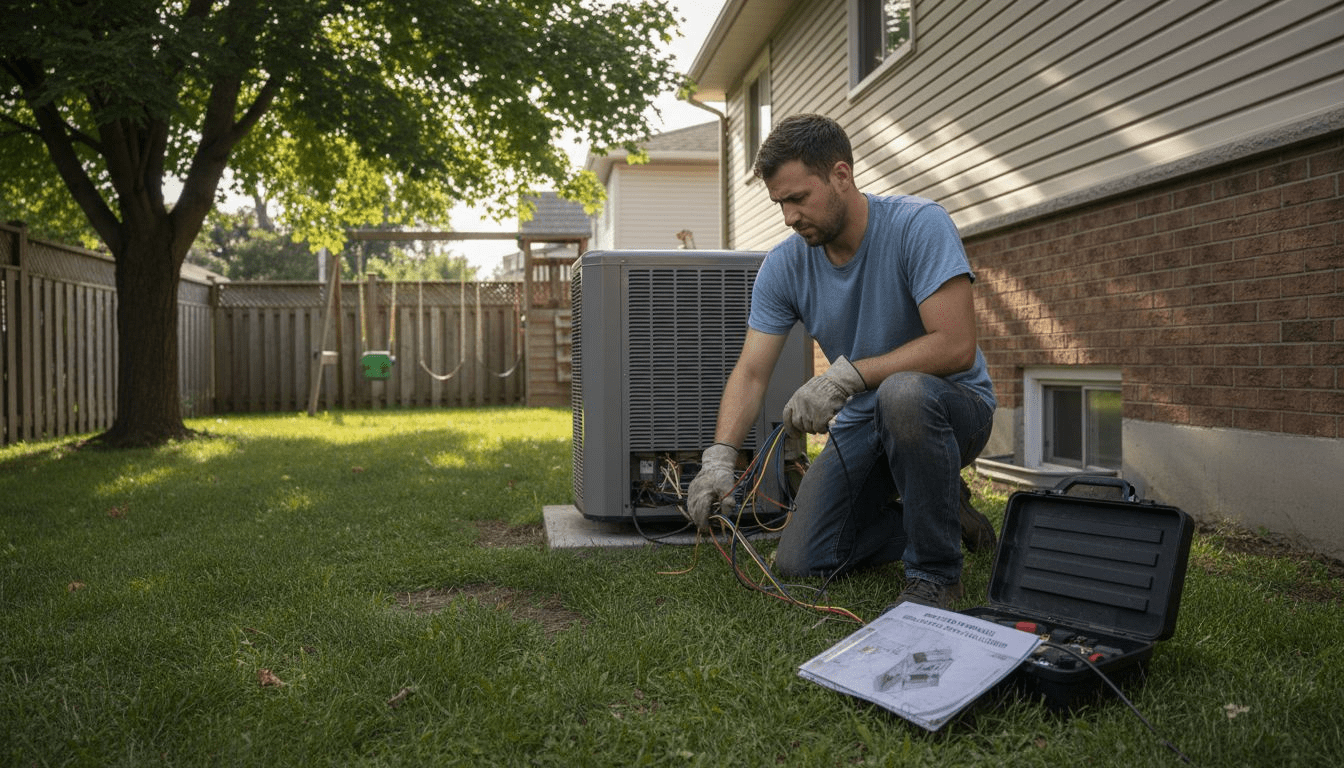
Heat pump installations can quickly turn stressful when unexpected issues arise. Whether you are a technician or a homeowner investing in a new system, small errors during setup often lead to higher bills, poor comfort, and expensive repairs down the line. The fact is, success starts with knowledge of the most common pitfalls that derail efficiency and reliability.
This list reveals practical steps that prevent costly mistakes, improve system performance, and deliver consistent comfort throughout your home. You will learn specific, actionable solutions grounded in proven industry guidance—not vague advice or unreliable shortcuts.
Get ready to discover the key details that top Canadian installers never overlook. These insights will help you avoid frustration, protect your reputation, and ensure your heat pump performs at its best for years to come.
Table of Contents
- 1. Selecting The Wrong Heat Pump Size For The Home
- 2. Improper Placement Of Outdoor Units
- 3. Inadequate Insulation And Sealing Of Ducts
- 4. Incorrect Refrigerant Charging Techniques
- 5. Neglecting Proper Electrical Connections
- 6. Skipping Essential System Testing And Commissioning
Quick Summary
| Key Message | Explanation |
|---|---|
| 1. Proper Heat Pump Sizing is Essential | Accurate load calculations prevent under- or oversized units, ensuring optimal performance and customer satisfaction. |
| 2. Outdoor Unit Placement Affects Performance | Correct placement ensures adequate airflow and system efficiency, avoiding future maintenance issues and high energy bills. |
| 3. Seal Ducts to Improve Efficiency | Proper sealing and insulation of ducts prevent energy loss and maintain even temperatures, reducing operational costs for customers. |
| 4. Accurate Refrigerant Charging is Critical | Following precise charging procedures ensures efficient operation and longevity of heat pump systems, avoiding costly repairs. |
| 5. Commissioning is a Final Quality Check | Proper testing and documentation during commissioning catch potential issues, ensuring the system operates as intended and increases client trust. |
1. Selecting the Wrong Heat Pump Size for the Home
Getting the sizing right is where many installations go wrong from the start. An undersized or oversized heat pump will never perform as intended, leaving you dealing with frustrated customers and costly service callbacks.
When a unit is undersized, it struggles during cold Canadian winters, forcing the system to work overtime and lean heavily on backup heating. This means your customers pay more for heat while the system runs continuously without meeting demand. On the flip side, oversized units short-cycle—they reach the desired temperature and shut off quickly, then cycle back on again shortly after.
Proper load calculations determine everything. Without them, you’re essentially guessing, and guesses rarely work out in the field.
Short-cycling creates several problems that haunt you later:
- Reduced dehumidification capability, leading to comfort complaints
- Increased wear and tear on compressors and components
- Higher energy bills despite purchasing a “powerful” unit
- Poor temperature consistency throughout the home
Natural Resources Canada provides detailed guidance on proper heat pump sizing procedures.pdf), emphasizing that accurate heating and cooling load calculations form the foundation of every installation. Skip this step and you set yourself up for failure.
The right approach requires calculating the home’s design heating load and cooling load based on square footage, insulation quality, window types, air infiltration, and local climate data. This isn’t a rough estimate or rule of thumb—it’s precise engineering. You’re determining exactly how many kilowatts of heating and cooling capacity the unit actually needs.
Consider a 2,000-square-foot home in Toronto. Two technicians might recommend completely different unit sizes if one uses manual calculations while the other guesses. The one using proper load calculations will size correctly; the other will likely go too large or too small.
Once you’ve calculated the load, match it to an indoor unit that handles that capacity without oversizing. Your customer gets reliable performance, consistent comfort, and reasonable operating costs. You get satisfied clients who refer their neighbours.
Proper heat pump placement and indoor unit selection work together, so understanding how location factors affect efficiency helps ensure your sizing calculations translate into real-world performance.
Pro tip: Use Manual J calculations or approved load calculation software every single time—never rely on manufacturer shortcuts or simple square-footage rules that ignore climate zone, building envelope quality, and local heating/cooling demands.
2. Improper Placement of Outdoor Units
The outdoor condenser unit is not just a box you can tuck anywhere convenient on the property. Poor placement creates airflow restrictions that tank performance and invite expensive callbacks within months of installation.
A condenser unit needs to breathe. When you restrict the air flowing across its coils, the system works harder to reject heat, which raises discharge pressures, reduces efficiency, and shortens component lifespan. Homeowners blame you when their utility bills spike or the system fails unexpectedly.
Common placement mistakes include positioning units against walls, in corners, or between structures. These locations starve the unit of fresh air and force it to recirculate warm exhaust air back through the coils. The system never reaches design capacity.
Clearances are not suggestions. They are minimum requirements to maintain rated performance and reliability.
According to ASHRAE standards, minimum clearances around air-cooled condensing units should include at least 36 inches from walls and 72 inches between multiple units. These distances ensure adequate airflow on all sides, especially around the discharge and intake areas.
Key placement considerations for outdoor units:
- Position away from walls, fences, and dense vegetation that blocks airflow
- Maintain clear space above and below the unit for proper circulation
- Avoid areas with high foot traffic or where equipment could be blocked later
- Protect from direct water runoff during heavy rainfall
- Keep distant from heat sources like dryer vents or exhaust pipes
Location also affects long-term maintenance and access. A unit crammed into a tight corner becomes difficult to service, and technicians will charge premium rates for challenging repairs. Strategic placement saves your customer money down the road.
Consider seasonal factors too. In Canadian winters, ensure the outdoor unit won’t accumulate excessive snow or ice that restricts airflow. Position it where air can flow freely in all directions, even during harsh weather.
Understanding heat pump placement for energy efficiency helps you recognize how location directly impacts both performance and operating costs throughout the year.
Pro tip: Always measure and mark minimum clearance zones before installation, then verify clearances after completing the job—take photos to document compliance and protect yourself from future disputes.
3. Inadequate Insulation and Sealing of Ducts
Leaky ducts are silent performance killers. Conditioned air escapes through unsealed seams and poorly insulated sections, leaving your customer with uneven temperatures, higher energy bills, and complaints that bring you back for warranty issues.
Think of your ductwork as a delivery system. If the pipes have holes, the product never reaches its destination. With heat pump systems, this problem multiplies because the system works harder to compensate for lost airflow, driving up operational costs and wearing out components prematurely.
Duct leakage happens at predictable points. Seams where duct sections connect, penetrations through walls and ceilings, and cabinet junctions around air handlers and evaporator coils all represent potential leak sites. Without proper sealing, you’re essentially throwing efficiency out the window.
A well-sealed duct system delivers what you promise. A leaky one delivers excuses.
Proper sealing requires the right materials. Mastic sealant and UL-approved foil tape are industry standards for sealing HVAC cabinet seams and duct joints. These products create airtight barriers that last far longer than standard duct tape, which deteriorates over time.
Critical areas to seal during every installation:
- All duct seams and joints where sections connect
- Evaporator coil cabinet penetrations and access points
- Air handler cabinet where ducts attach
- Return air plenum connections
- Supply side branch takeoffs and transitions
Insulation adds another layer of protection. Ducts running through unconditioned spaces like attics or crawlspaces lose temperature as air travels through them. Proper R-value insulation minimises this loss and maintains the air temperature your system worked hard to condition.
During installation, take time to seal every connection properly. Rushed work here leads to callbacks later. Your customers see energy bills spike and wonder why their new heat pump system isn’t performing. You want them satisfied and referring work, not posting frustrated reviews online.
Pro tip: Carry a handheld duct blaster or use smoke pencils to identify leaks before finishing the job—fixing problems during installation takes minutes, while chasing callbacks takes hours and damages your reputation.
4. Incorrect Refrigerant Charging Techniques
Refrigerant charge is not something you guess at or estimate based on experience. Getting it wrong creates inefficient systems that fail prematurely and cost your customers thousands in wasted energy and repairs.
When refrigerant charge is incorrect, the system cannot absorb or reject heat properly. An undercharged system struggles to reach temperature setpoints and runs continuously without satisfaction. An overcharged system raises discharge pressures, reduces efficiency, and stresses the compressor until it fails.
Both scenarios lead to the same outcome: unhappy customers and damaged reputation. The only way to charge correctly is using proper testing instruments and accepted measurement procedures based on superheat and subcooling calculations.
Eyeballing refrigerant charge is not a technique. It is negligence that will come back to haunt you.
Different expansion devices require different testing approaches. Thermostatic expansion valves (TXV) rely on superheat measurement at the evaporator outlet. Fixed orifice systems use subcooling measurement at the condenser outlet. Understanding which method applies to your specific system prevents costly mistakes.
Proper refrigerant charging procedures require qualified technicians using calibrated instruments to measure temperatures and pressures accurately. This is not the place to cut corners or rely on old-school methods that worked years ago.
Key steps for accurate refrigerant charging:
- Connect gauges to service ports and allow system to stabilise
- Measure temperature and pressure at the required locations
- Calculate superheat or subcooling based on saturation temperatures
- Add or recover refrigerant in small increments, allowing time between adjustments
- Recheck measurements after each adjustment until within specification
Refrigerant handling itself carries safety and environmental responsibilities. Proper storage and handling practices protect you, your crew, and the environment while ensuring system integrity.
Most modern heat pumps specify exact charge amounts in grams. Follow the manufacturer’s specifications precisely rather than assuming a standard charge will work across different models and configurations.
Pro tip: Keep detailed records of charge amounts, temperatures, and pressures for every installation—this documentation protects you legally and helps diagnose future issues quickly if customers report problems.
5. Neglecting Proper Electrical Connections
Electrical connections are not optional details you can rush through. Loose wires, improper grounding, and incorrect component installation create fire hazards, system failures, and liability that follows you long after the job is done.
Heat pump systems depend on precise electrical circuits. Capacitors provide the surge needed to start compressors. Contactors control power flow to major components. Relays manage signal circuits. Every connection matters, and every mistake compounds performance problems.
A loose connection generates heat through resistance. Over time, that heat degrades insulation and creates fire risk. Your customer could lose their home because you took shortcuts during installation. That scenario is not hypothetical.
Electrical work is not where you save time. It is where you prevent catastrophe.
Proper electrical connections require understanding essential HVAC electrical components and their correct installation. Each component has specific wiring requirements, voltage specifications, and safety considerations that manufacturers detail in their manuals.
Critical electrical tasks for every installation:
- Follow manufacturer wiring diagrams exactly as specified
- Use correctly sized wire gauges for each circuit
- Secure all connections with appropriate terminals and fasteners
- Verify proper grounding connections to prevent shock hazards
- Test all circuits before energising the system
- Label all wires clearly for future technicians
Electrical codes and standards exist because people learned hard lessons. The National Electrical Code and NFPA standards protect lives and property. Ignoring these guidelines is not just poor practice; it is illegal and uninsurable.
Capacitors need special attention. These components store electrical energy and can deliver dangerous shocks even when power is shut off. Always discharge capacitors safely before touching them, and replace any that show signs of failure like bulging tops or leaking.
Proper electrical equipment maintenance ensures heat pump systems operate safely and reliably throughout their lifespan. Preventive electrical inspections catch problems before they become dangerous.
Take time to verify every connection. Pull on wires to ensure they are seated properly. Check terminal tightness with appropriate tools. Test for proper voltage and continuity once installation is complete. These minutes of extra work prevent years of problems.
Pro tip: Always photograph your electrical connections before closing panels—visual documentation protects you if issues arise later and helps other technicians understand your work.
6. Skipping Essential System Testing and Commissioning
You have installed the equipment, made all the connections, and charged the system. Now comes the part many technicians rush through: verifying that everything actually works as designed. Skipping this step invites warranty claims, customer dissatisfaction, and your own liability.
Commissioning is not optional paperwork. It is the systematic process of testing, adjusting, and verifying that your heat pump system meets performance requirements and operates safely. Without it, you hand over a system to your customer that may have hidden defects or performance issues.
An untested system might seem to run, but it could be operating inefficiently, delivering uneven heating or cooling, or harbouring problems that emerge weeks later. Your customer then calls you back frustrated, and you lose credibility plus the cost of a service callback.
Commissioning is your final quality check. Skip it and you are delivering hope, not performance.
Proper HVAC system commissioning involves systematic testing and verification of all components, controls, and performance criteria. You measure actual performance against design specifications and document everything.
Essential commissioning tasks for heat pump installations:
- Verify all electrical connections are secure and properly grounded
- Test heating and cooling operation at design conditions
- Measure temperature differences across indoor coils
- Confirm thermostat programming and sensor operation
- Check refrigerant charge using superheat and subcooling methods
- Validate ductwork sealing and insulation performance
- Document all test results and observations
Testing reveals problems while you are still on site and can fix them. A temperature difference that is too small might indicate inadequate airflow or refrigerant charge issues. Uneven heating between rooms points to duct balancing problems. These discoveries during commissioning save your reputation.
Documentation matters. Effective commissioning includes detailed records of all tests performed, results obtained, and any deficiencies found and corrected. This paperwork protects you legally and provides the customer with proof that their system was properly installed and tested.
Train your customer on system operation before you leave. Show them how to use controls, set temperatures, and recognize normal operation. An educated customer becomes an advocate rather than a source of complaints.
Pro tip: Create a simple commissioning checklist you use on every installation, photograph all test readings with timestamps, and leave a copy with the customer—this documentation becomes your defence if disputes arise later.
Below is a comprehensive table summarising the key considerations and practices for heat pump installation as discussed in the article.
| Aspect | Key Points | Importance |
|---|---|---|
| Selecting Correct Unit Size | Proper load calculations are crucial to avoid undersized or oversized systems. | Ensures efficiency, comfort, and cost-effectiveness. |
| Outdoor Unit Placement | Adequate space and strategic location are needed for optimal airflow and maintenance access. | Prevents performance bottlenecks and premature component damage. |
| Duct Insulation and Sealing | Ensure all duct seams are adequately sealed and insulated. | Prevents energy loss, reduces operational costs, and ensures consistent airflow. |
| Refrigerant Charging Accuracy | Use precise instruments and follow accepted procedures. | Guarantees system efficiency and extends the equipment’s lifespan. |
| Proper Electrical Connections | Adhere to manufacturer specifications for wiring and connection. | Avoids safety hazards and ensures operational reliability. |
| System Testing and Commissioning | Perform systematic tests, adjustments, and validations post-installation. | Identifies and corrects potential issues, assuring customer satisfaction. |
Adhering to these guidelines ensures the effective operation, longevity, and efficiency of heat pump systems while enhancing customer satisfaction.
Avoid Common Heat Pump Installation Mistakes with Expert Support
Incorrect heat pump sizing, poor outdoor unit placement, and improper refrigerant charging can cause frustrating performance issues and costly callbacks. If you want to ensure your heat pump installation is done right the first time, avoid the common pitfalls described in this article and benefit from professional expertise focused on reliable, energy-efficient solutions. Key aspects like accurate load calculations, proper duct sealing, and thorough system testing require precision and experience to protect your investment and comfort.

Take the first step toward flawless heat pump installation by partnering with trusted technicians at CoolFix. We understand Canadian climate challenges and follow industry best practices to deliver lasting performance. Learn more about our comprehensive heat pump installation in appliance repair services and how we tackle every detail from start to finish. Don’t wait until costly issues appear. Visit CoolFix today and secure your home comfort with expert solutions.
Frequently Asked Questions
What are the common heat pump installation mistakes to avoid?
Many common mistakes include selecting the wrong heat pump size, improper placement of outdoor units, inadequate insulation and sealing of ducts, incorrect refrigerant charging techniques, neglecting proper electrical connections, and skipping essential system testing and commissioning. To avoid these issues, ensure that you follow precise installation protocols and verify every step.
How can I determine the correct size of a heat pump for my home?
To accurately size a heat pump, perform detailed heating and cooling load calculations based on your home’s square footage, insulation quality, and local climate data. Use methods like Manual J calculations to identify the exact capacity needed for effective heating and cooling.
What should I consider when placing outdoor units during installation?
When placing outdoor units, ensure there is ample clearance for airflow, avoiding walls, corners, or dense vegetation. Maintain a minimum of 36 inches from walls and 72 inches between multiple units to ensure optimal performance and prevent system overheating.
What techniques should I use for sealing ducts?
To effectively seal ducts, use mastic sealant and UL-approved foil tape at all seams and joints. Focus on common leak points such as connections and access points to ensure that conditioned air does not escape, reducing energy loss by 15-30%.
Why is refrigerant charging critical during heat pump installation?
Proper refrigerant charging is crucial because an incorrect charge can lead to system inefficiencies, increased energy costs, and premature component failure. Always use accurate measurement techniques, such as superheat and subcooling methods, to ensure optimal performance.
How can I ensure that the heat pump system is working correctly after installation?
Conduct thorough testing and commissioning after installation to verify that all components function correctly and meet performance requirements. Document test results and fix any issues on-site to ensure the system operates efficiently and satisfactorily.
Recommended
- Heat Pump Placement Explained: Energy Savings at Home – CoolFix Appliance & HVAC Service
- Heat Pump Installer Role: Elevating Installation Skills – CoolFix Appliance & HVAC Service
- Heat Pump Installation Permits – Compliance for Canadians – CoolFix Appliance & HVAC Service
- Heat Pump Location Factors – Maximizing Efficiency in Canada – CoolFix Appliance & HVAC Service
0 Comments